
Material-Based Equipment Selection
Can Our Equipment Process Your Material?
That is the first question many customers ask. YAKU reviews the material, approximate viscosity, batch volume, vessel dimensions and process goal before recommending a disperser or mixer configuration.
For an initial cross-border assessment, you normally do not need to ship material. Send a clear material video and your available process information so the application can be reviewed remotely.
Photo and video updates can be provided during the projectA Practical First Assessment
Show Us How the Material Behaves
A material name alone is rarely enough. A short video often helps show whether it pours, stretches, forms lumps, traps air or changes during mixing.
Application Experience
Materials Customers Ask Us About
These application groups show the range of enquiries YAKU receives. They do not mean one machine is suitable for every material in the category.
Water-Based Coatings
Pigment wetting, powder incorporation, formulation trials and small-batch coating preparation.
Explore coatings applications →Inks & Color Paste
Applications where dispersion tool, speed range, batch size and target fineness need to be considered together.
Explore ink applications →Resins & Adhesives
Viscosity may change during processing, so motor load, tool selection and operating duty require application review.
Explore chemical applications →University Laboratories
Sample preparation, formulation comparison and compatible material testing in compact laboratory batches.
Explore university solutions →New Energy Materials
Material solids, viscosity, batch scale, contamination requirements and processing target must be confirmed before selection.
Explore new-energy applications →Food & Minced-Meat Mixing
Food processes may require a different agitator, vessel and food-contact configuration. The exact material and required mixing action must be reviewed first.
Explore food applications →From Material to Product Family
Which Equipment Should You Review First?
No product family is selected from the industry name alone. The following options provide a starting point; the specific model is confirmed after reviewing the process details.
Laboratory High-Speed Dispersers
For formulation, sample preparation and compatible laboratory dispersion work. The current laboratory range uses an approximate 1–10 L working reference, subject to material and vessel conditions.
Review laboratory dispersers →High-Speed Dispersers
For laboratory, pilot and small-batch applications where motor, speed, disc diameter, lifting method and vessel need to be matched.
Review high-speed dispersers →Vacuum Dispersers
For compatible processes where air removal and enclosed observation are part of the application requirement.
Review vacuum dispersers →Multi-Shaft Mixers
For applications that may require combined mixing actions, especially when a single high-speed dispersing tool is not enough for the material behavior.
Review multi-shaft mixers →University & Laboratory Experience
Equipment for Research Environments
YAKU equipment has been supplied for laboratory use associated with research and teaching users at Chinese universities, alongside industrial customers in China and overseas markets.
Institution names identify reported equipment-use or project destinations and do not imply institutional endorsement.
- Tsinghua University
- Wuhan University
- Nanjing University of Science and Technology
- Other university and enterprise laboratories
Application-Specific Configuration
What Can Be Customized?
YAKU can review a broad range of configuration requests. Feasibility, specifications, safety requirements and final scope are confirmed through engineering review before the order.
- Working capacity and vessel size
- Motor power and speed range
- Shaft length and dispersing tool
- Manual, electric or hydraulic lift
- Voltage, phase and frequency
- Contact-part material
- Vacuum or enclosed configuration
- Hazardous-area requirements
- Other application-specific requests
Send Useful Information
Help Us Understand Your Material
More complete information makes the initial model discussion more useful.
- A short video showing the material’s flow and consistency
- Material name, composition or general application
- Measured viscosity or a practical viscosity description
- Minimum and maximum working volume
- Container inside diameter and height
- Current problem and expected process result
- Available voltage, phase and frequency
- Any vacuum, food-contact or hazardous-area requirement
Application FAQ
Before You Ask for a Recommendation
Can YAKU confirm suitability from a material video?
A video is useful for an initial assessment, especially when combined with viscosity, batch volume, vessel dimensions and the required result. It does not replace complete technical information or final engineering confirmation.
Do I need to ship a material sample internationally?
Normally, YAKU recommends starting with video and process information because cross-border sample shipping can be expensive and restricted. If additional evaluation is needed, the practical next step can be discussed for the specific project.
Can one disperser process every material?
No. Material viscosity, solids, batch volume, vessel geometry, tool type and process target all influence equipment suitability. Some applications may require a vacuum or multi-shaft configuration instead of a standard disperser.
Can the equipment be customized?
Capacity, vessel, motor, shaft, dispersing tool, lift, electrical supply and other features can be reviewed for customization. Availability and final specifications are subject to engineering and safety confirmation.
Can you provide photos or video?
Yes. Project photos and video updates can be provided during the equipment confirmation or production process according to the agreed scope.
Start With the Material
Not Sure Which Machine Fits?
Send a material video, approximate viscosity, batch volume, container dimensions and your expected result. YAKU will review the application and discuss a suitable product family and configuration.
Customer Case
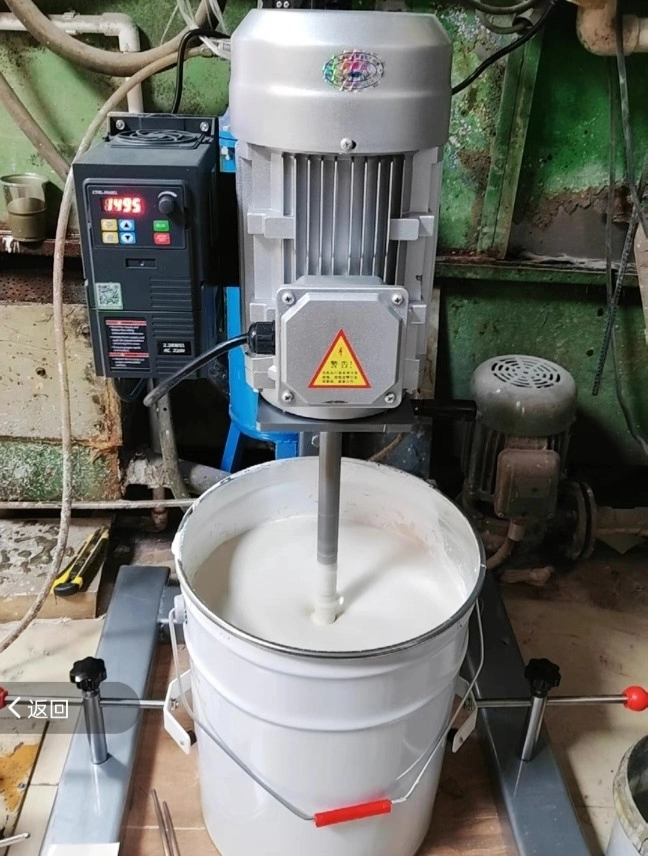
Industry: Coatings
Location: China
Equipment: YAKU 1.1 kW High Speed Disperser
This Chinese coating manufacturer has been a long-term customer of YAKU.
By using the YAKU 1.1 kW high speed disperser, the company achieved more efficient mixing and dispersion during production. The improved processing efficiency helped increase production capacity and productivity while maintaining consistent mixing performance.
The customer continues to use YAKU equipment for its coating production, making this a long-term cooperation built on reliable machine performance.