
High-Speed Disperser Selection Guide
Choose the Motor Around Your Process—not Power Alone
The right high-speed disperser motor depends on material viscosity, batch volume, dispersing-disc diameter, required speed range, run time and working-area requirements.
Send YAKU your process information and we will help match the drive, speed control, lift, shaft and disc as one working system.
The Short Answer
There Is No Universal “Best” Disperser Motor
A larger kW rating does not automatically deliver a better dispersion result. It must be matched to the material load, disc size, operating speed, vessel geometry and intended duty.
Process Load
Viscosity, density, solids content and how the material changes during processing determine the actual load on the drive.
Dispersion Tool
Disc diameter and design affect power demand and tip speed. A motor cannot be selected independently from the dispersing tool.
Operating Duty
Short formulation trials and repeated production batches can require different thermal margin, controls and machine structure.
Drive & Control Options
How the Main Configurations Differ
Use these categories to narrow the choice. Final suitability still needs to be checked against the exact product specification and your process.
Electronic or Brushless Laboratory Drive
Common on compact laboratory dispersers where a broad adjustable speed range and a small footprint are important. Compare actual power, speed range, lift stroke and shaft/disc size by model.
Variable-Frequency Drive (VFD)
Used to regulate motor speed on selected pilot and small-batch machines. VFD control is useful for controlled acceleration and speed adjustment, but it does not replace correct power and disc selection.
Manual or Electric Lift
The lift type does not determine motor performance, but it changes loading, cleaning and vessel-change workflow. Select it together with the required stroke and container height.
Explosion-Protected Configuration
For a classified hazardous area, the complete machine configuration—not only the motor—must be reviewed against the required area classification, protection concept, electrical standard and documentation.
Verified Product References
Compare Current YAKU Configurations
The table below uses current product-page specifications as reference points. It is designed to help you shortlist a machine, not to assign a model from batch size alone.
| Model | Published Motor | Published Speed | Lift / Reference | Selection Note |
|---|---|---|---|---|
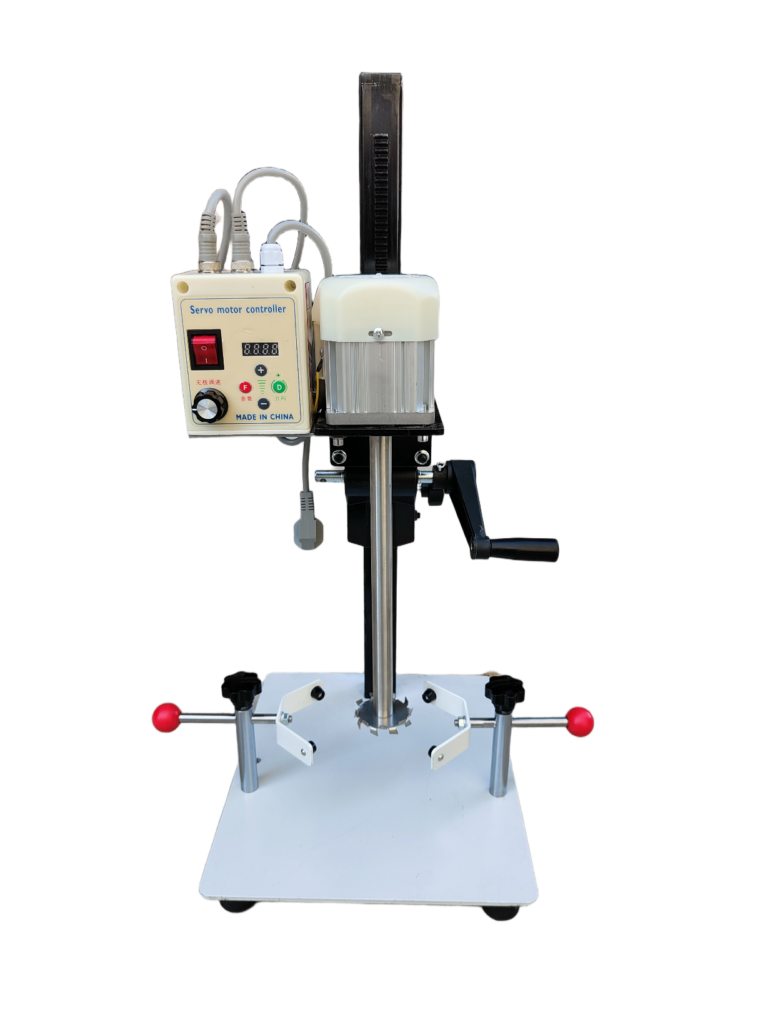
| FS-750 Manual Lift | 750 W brushless | 0–6,500 r/min | Manual crank; 0–40 cm stroke | Evaluate for laboratory work using the required disc, material load and vessel. |
| YKFS-1.1 Manual Lift | 1.1 kW brushless with VFD | 0–3,000 r/min | Manual lift; published capacity ≤25 L* | A reference for higher-load laboratory or small-batch work. |
| YKFS-1.1 Electric Lift | 1.1 kW | 0–3,000 r/min | Electric lift; published capacity up to 25 L* | Consider when powered lifting better suits vessel changes and cleaning. |
*Capacity depends on material viscosity and process conditions. Confirm current voltage, included shaft/disc, dimensions and other specifications before ordering.
Five-Step Selection
Select the Motor in the Right Order
Speed vs. Dispersion
Why Maximum RPM Is Not Enough
Two dispersers running at the same shaft speed can behave differently when their disc diameters are different. Tip speed links shaft speed with tool diameter:
Higher tip speed can increase shear, but the correct operating point also depends on material flow, vortex formation, vessel geometry, temperature rise and motor load. Do not select a machine from maximum RPM alone.
Questions to Ask Before Comparing kW
- What viscosity range must the machine handle?
- What are the minimum and maximum batch volumes?
- Which disc diameter and shaft length will be used?
- How long will each run last?
- Is speed display or repeatable speed setting required?
- What electrical supply is available at the site?
- Is the work area formally classified as hazardous?
Solvent and Hazardous-Area Applications
A solvent-based product name by itself does not determine a compliant machine. Before quotation, provide the hazardous-area classification, required protection marking or local standard, gas or dust group, temperature class, voltage and installation location. YAKU should confirm the proposed motor, controls and related electrical components as a complete configuration. Final site compliance remains subject to the buyer’s qualified safety review and local requirements.
Shortlist Models
Continue to the Relevant Product Page
FS-750 Manual Lift
750 W brushless motor, variable speed up to 6,500 r/min and manual crank lift.
View FS-750 specifications →YKFS-1.1
1.1 kW drive, VFD speed control and a published maximum capacity subject to material viscosity.
View YKFS-1.1 specifications →All High-Speed Dispersers
Compare laboratory, electric-lift and model-specific explosion-protected options.
Browse the product catalogue →Prepare for a Useful Recommendation
Send These Process Details
A complete request helps YAKU review the motor, control, lift, shaft, disc and vessel together.
- Material name and intended application
- Approximate viscosity and density
- Batch volume per run
- Vessel inside diameter and height
- Current process or target dispersion result
- Run time and batches per day
- Voltage, phase and frequency
- Hazardous-area classification, if applicable
- Destination country or port
- Preferred manual or electric lift
Buyer Questions
High-Speed Disperser Motor FAQ
Is a higher-power motor always the better choice?
No. An oversized drive does not correct an unsuitable disc, vessel or operating speed. Select enough power and torque for the real process load, with an appropriate operating margin.
Can I choose a disperser from batch volume alone?
No. The same volume can impose very different loads depending on viscosity, density, solids content, disc size and the way the formulation changes during dispersion.
Does maximum RPM show how well a machine will disperse?
Not by itself. Disc diameter, tip speed, vessel geometry, circulation pattern and material behavior also affect the result.
Do I need an explosion-protected motor for solvent-based material?
The answer must be based on a formal risk assessment and the site’s hazardous-area classification. Confirm the required protection and documentation for the complete machine with YAKU before ordering.
What should be confirmed for long or repeated operation?
Provide run time per batch, batches per day, expected load, ambient conditions and cooling breaks. YAKU can then check whether the proposed drive and machine structure suit the intended duty.
Can voltage and plug type be configured?
Available electrical options vary by model. Send the destination voltage, phase, frequency and plug or wiring requirement before the order is confirmed.
Get a Process-Based Recommendation
Tell Us What You Need to Disperse
Send your material, viscosity, batch size, vessel dimensions, run time, electrical supply and safety requirements. YAKU will review a suitable high-speed disperser configuration for your application.