
Battery & New Energy Mixing Solutions
YAKU supplies battery slurry mixing equipment for laboratory formulation, process development, pilot work, and compatible small-to-medium batches. We review the mixer from your slurry viscosity, solids content, batch volume, vessel, target result, and solvent system.
A high-speed disperser can be useful for powder wet-out and de-agglomeration in a flowable slurry. High-viscosity electrode paste, vacuum degassing, or particle-size reduction may require a different or combined solution. YAKU recommends the configuration after reviewing the real process.
Send These Details First
- Cathode, anode, conductive, binder, or other slurry
- Carrier liquid or solvent and safety data
- Starting and maximum viscosity
- Solids content and powder addition sequence
- Minimum and maximum working volume
- Vessel inside diameter, height, and opening
- Required fineness, uniformity, vacuum, and temperature control
A material name alone is not enough for final model selection. A short mixing video is also useful when viscosity data is unavailable.
Lab, Pilot and Small-Batch Review
High-Speed, Geared and Vacuum Options
Configuration Based on Real Slurry Data
Choose Battery Slurry Equipment by Process Requirement
The correct battery slurry mixer depends on how the formulation behaves during processing. Maximum rpm or tank volume alone cannot tell you whether the machine will circulate, disperse, degas, or reduce particle size correctly.
| Process requirement | Equipment starting point | What must be checked |
|---|---|---|
| Wet and distribute powder into a flowable liquid phase | Variable-speed high-speed disperser | Viscosity curve, solids, powder addition rate, vessel geometry, disc size, and target dispersion |
| Move high-solids slurry or paste that does not circulate around a dispersing disc | Geared low-speed or multi-shaft configuration | Maximum viscosity, torque, wall movement, heat generation, and discharge method |
| Reduce entrained air before coating or testing | Sealed vacuum disperser or mixer | Foaming behavior, vacuum requirement, vessel seal, temperature, and process sequence |
| Reach a finer particle-size target after pre-dispersion | Compatible milling stage | Starting particle size, target fineness, throughput, contamination limits, and test method |
For a practical explanation of the dispersion stage, see the lithium battery slurry dispersion guide.
YAKU Model References for Slurry Development and Scale-Up
The models below are starting references. Published container or capacity figures are not guaranteed working volumes for battery slurry. Usable batch size depends on viscosity, density, solids, vessel dimensions, disc position, motor load, and the required result.
| Model | Published specification | Possible starting use | Selection note |
|---|---|---|---|
| YKFS-350T Chuck Type | 350 W, 0-4000 rpm, up to 5 L water reference | Small formulation tests and frequent shaft changes | Actual volume falls as viscosity and load rise |
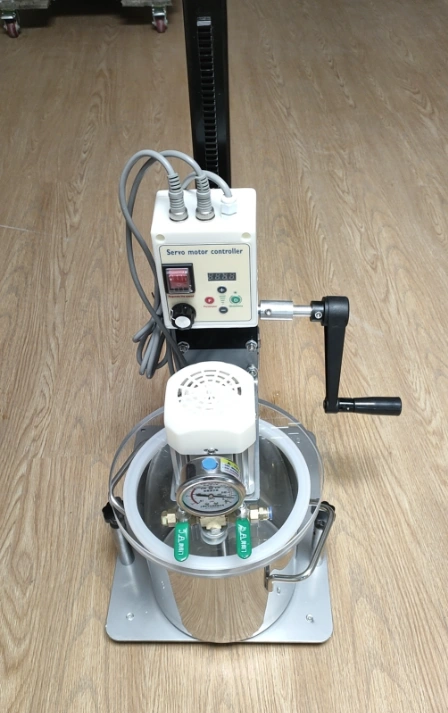
| YKFS-1100K Vacuum Model | 1100 W, 0-5000 rpm, published 6 L vacuum bucket | Small-batch dispersion where vacuum review is required | Confirm wetted materials, seals, formulation compatibility, and required vacuum process |
| FS-1.1 Electric Lift | 1.1 kW, 0-3000 rpm, published 25 L maximum container capacity | Process development and compatible flowable pilot batches | Container capacity is not the same as usable slurry volume |
| FS-3KW Variable-Speed | 3 kW, 0-3000 rpm, published capacity up to 150 L subject to process conditions | Compatible pilot and small-to-medium batches | High-solids paste may require more torque or another mixing structure |
Why a Capacity Number Is Not Enough
- Viscosity can rise sharply after active material and conductive additive are charged.
- High solids and dense powders increase motor load.
- A narrow vessel can prevent the circulation needed for dispersion.
- Disc diameter and working position change flow and power demand.
- The process may need bulk movement, wall scraping, vacuum, or cooling in addition to shear.
If viscosity is unknown, start with the YAKU liquid viscosity guide and provide a short flow video.
Battery Materials and Development Tasks We Can Review
YAKU can review equipment for compatible cathode, anode, conductive, binder, separator-coating, and other new-energy material formulations. Suitability is confirmed from the actual recipe and process information rather than the material name alone.
Cathode and Anode Slurries
Formulations containing LFP, NMC, graphite, silicon-based materials, binders, and compatible carrier liquids can be reviewed from their actual viscosity and solids data.
Conductive Dispersions
Carbon black, CNT, graphene, and other conductive-additive systems require review of powder wet-out, agglomeration, carrier compatibility, and the measurable dispersion target.
R&D and Process Scale-Up
Lab formulation, material screening, sample preparation, pilot validation, and compatible small-batch work can be matched to different motor, lift, shaft, disc, and vessel options.
Important: YAKU does not determine equipment suitability from chemistry names alone. Binder type, carrier liquid, particle behavior, target rheology, contamination limits, and facility requirements must be reviewed.
High-Viscosity Battery Slurry Needs Torque and Bulk Flow
A high-speed disc is effective only when the slurry can circulate through the shear zone. If the batch becomes too thick to move, increasing rpm may not solve the problem and can increase heat or motor load.
- Flowable slurry: a variable-speed high-speed disperser may provide the required powder wet-out and dispersion.
- Thick slurry or paste: a geared low-speed shaft, anchor, or multi-shaft arrangement may be needed to create bulk movement.
- Air-sensitive coating process: a sealed vacuum stage may be required after or during mixing.
- Fine particle-size target: a milling step may be needed after pre-dispersion.
YAKU can review different combinations instead of forcing every application into one standard disperser.
What Determines the Final Configuration?
1. Slurry Rheology and Solids
Provide starting and peak viscosity, solids percentage, density, powder type, and the point where the batch becomes difficult to circulate.
2. Batch and Vessel Geometry
Minimum volume matters as much as maximum volume. Vessel diameter, height, opening, and required shaft clearance affect disc immersion and circulation.
3. Result and Test Method
State how you judge success: visible agglomerates, fineness, viscosity, coating appearance, bubble level, batch time, or another measurable result.
4. Contact Materials and Cleaning
Identify wetted-part requirements, contamination limits, cleaning method, formula change frequency, and whether a removable shaft or separate tools are preferred.
5. Vacuum and Temperature
Explain when air enters the process, the required vacuum stage, heat generated during mixing, and whether a jacketed vessel or temperature monitoring is needed.
6. Utilities and Site Safety
Provide voltage, phase, frequency, installation country, available space, and any hazardous-area classification or other site requirement.
Solvent-Based Slurries Require a Separate Safety Review
A standard battery slurry mixer must not be assumed suitable for a flammable solvent, vapor, combustible dust, vacuum duty, or a classified area. The complete electrical and mechanical configuration must be reviewed against the buyer’s facility requirements.
- Provide the safety data sheet and carrier-liquid information.
- Provide the required zone or class, gas or dust group, temperature class, and applicable local standard.
- Confirm ventilation, grounding, wiring, motor, controls, switches, and related equipment as a complete system.
- Request the exact compliance documents required for the final quoted configuration before ordering.
Read the explosion-proof disperser selection guide before sending a solvent-process inquiry.
How YAKU Reviews a Battery Slurry Application
1. Review the Material
You provide the formulation type, carrier, solids, viscosity, batch range, vessel, target result, and site information.
2. Match the Process
YAKU checks whether you need high-speed dispersion, geared bulk mixing, vacuum, temperature control, milling, or a combined arrangement.
3. Confirm the Configuration
Motor, speed range, lift, shaft, disc, vessel clearance, wetted parts, voltage, and requested options are documented for review.
4. Quote the Agreed Scope
The final quotation should state the included configuration and any limits or buyer-supplied information that still requires confirmation.
Battery Slurry Mixer FAQ
Can one high-speed disperser process every battery slurry?
No. A high-speed disperser suits many flowable powder-into-liquid processes, but high-solids paste may need geared low-speed mixing, an anchor, a multi-shaft mixer, or another structure. Vacuum and milling are also separate process duties.
Can YAKU select a mixer from the battery chemistry name?
Not reliably. LFP, NMC, graphite, carbon black, CNT, and binder systems can have very different solids, viscosity, particle behavior, carrier liquids, and process targets. Those details must be reviewed.
When should I consider a vacuum slurry mixer?
Consider vacuum when entrained air interferes with coating, testing, density, or appearance. The required vacuum level, mixing sequence, foaming behavior, vessel seal, and material compatibility still need confirmation.
Does a larger container rating mean the machine can process that much battery slurry?
No. Container size is only a reference. Real working volume depends on viscosity, solids, density, disc diameter, vessel geometry, shaft position, motor load, and the required result.
Can YAKU customize the shaft, disc, lift, vessel clearance, or voltage?
These items can be reviewed for customization. Availability and final dimensions must be confirmed in the quotation or approved drawing for the selected model.
What should I send if I do not know the viscosity?
Send the material names, solids percentage, batch volume, vessel dimensions, current mixing method, and a short video showing how the slurry flows. YAKU can use this for an initial review and identify what data is still needed.
Request a Battery Slurry Mixer Configuration Review
Send your slurry type, carrier liquid, solids content, viscosity, working volume, vessel dimensions, target result, vacuum requirement, utilities, and installation country. YAKU will review an appropriate starting configuration for your lab, pilot, or compatible small-batch process.