
Chemical Processing Solutions
YAKU supplies chemical mixing equipment for formulation development, laboratory testing, pilot work, and small-to-medium batch production. We review the machine from your material, viscosity, batch volume, vessel dimensions, and required process result.
Choose from laboratory dispersers, variable-speed production dispersers, vacuum dispersers, multi-shaft mixers, dispersing tools, and compatible vessels. The correct configuration depends on what the material must do during the process, not only its name or tank capacity.
Send These Details First
- Material name or a short flow video
- Approximate starting and maximum viscosity
- Minimum and maximum working volume
- Vessel inside diameter and height
- Target result and current process problem
- Voltage, phase, frequency, and country
Solvent process? Also provide the facility’s hazardous-area requirements. A standard machine should not be assumed suitable.
Lab to 150 L Published Model References
Variable-Speed and Lift Options
Shaft, Disc, Clearance and Voltage Review
Match the Chemical Mixing Task to the Equipment
An industrial chemical mixer should be selected from the required operation. A high-speed disperser is useful for many powder-into-liquid processes, but it is not the correct answer for every chemical formulation.
| Process requirement | Equipment starting point | What must be checked |
|---|---|---|
| Wet and distribute pigment, filler, or other powder into a flowable liquid | Variable-speed high-speed disperser | Viscosity, solids content, vessel geometry, disc size, speed, and target result |
| Move a thick material that does not circulate around a dispersing disc | Geared or multi-shaft mixing configuration | Maximum viscosity, torque demand, wall movement, heat, and discharge method |
| Reduce bubbles in a compatible material under a sealed process | Vacuum disperser | Foaming behavior, vessel sealing, vacuum requirement, temperature, and material compatibility |
| Reduce particle size beyond normal wetting and de-agglomeration | Milling equipment after pre-dispersion | Starting particle size, required fineness, throughput, and test method |
| Simple liquid blending without strong shear | Lower-speed agitator or compatible mixing tool | Liquid viscosity, density difference, tank size, and blend time |
If you are unsure whether a disperser is suitable, read Can My Material Be Mixed with a Disperser? or send YAKU a short material video for an initial review.
Chemical Disperser Models by Batch Scale
These are published model references, not guaranteed processing capacities for every chemical. Usable volume depends on viscosity, density, solids content, vessel dimensions, disc diameter, shaft position, operating speed, and the required result.
| Model | Published specification | Practical starting use | Important limitation |
|---|---|---|---|
| YKFS-350T Chuck Type | 350 W, 0-4000 rpm, up to 5 L water reference | Laboratory formulation, sample preparation, and frequent shaft changes | Actual working volume decreases as load and viscosity increase |
| FS-1.1 Electric Lift | 1.1 kW, 0-3000 rpm, published 25 L maximum container capacity | R&D, pilot work, and flowable small chemical batches | Container capacity is not a guarantee of usable batch volume |
| YKFS-1.5 Manual Lift | 1.5 kW, 0-3000 rpm, published capacity up to 50 L depending on viscosity | Pilot and small production batches requiring more drive power | High viscosity may require lower-speed torque or another configuration |
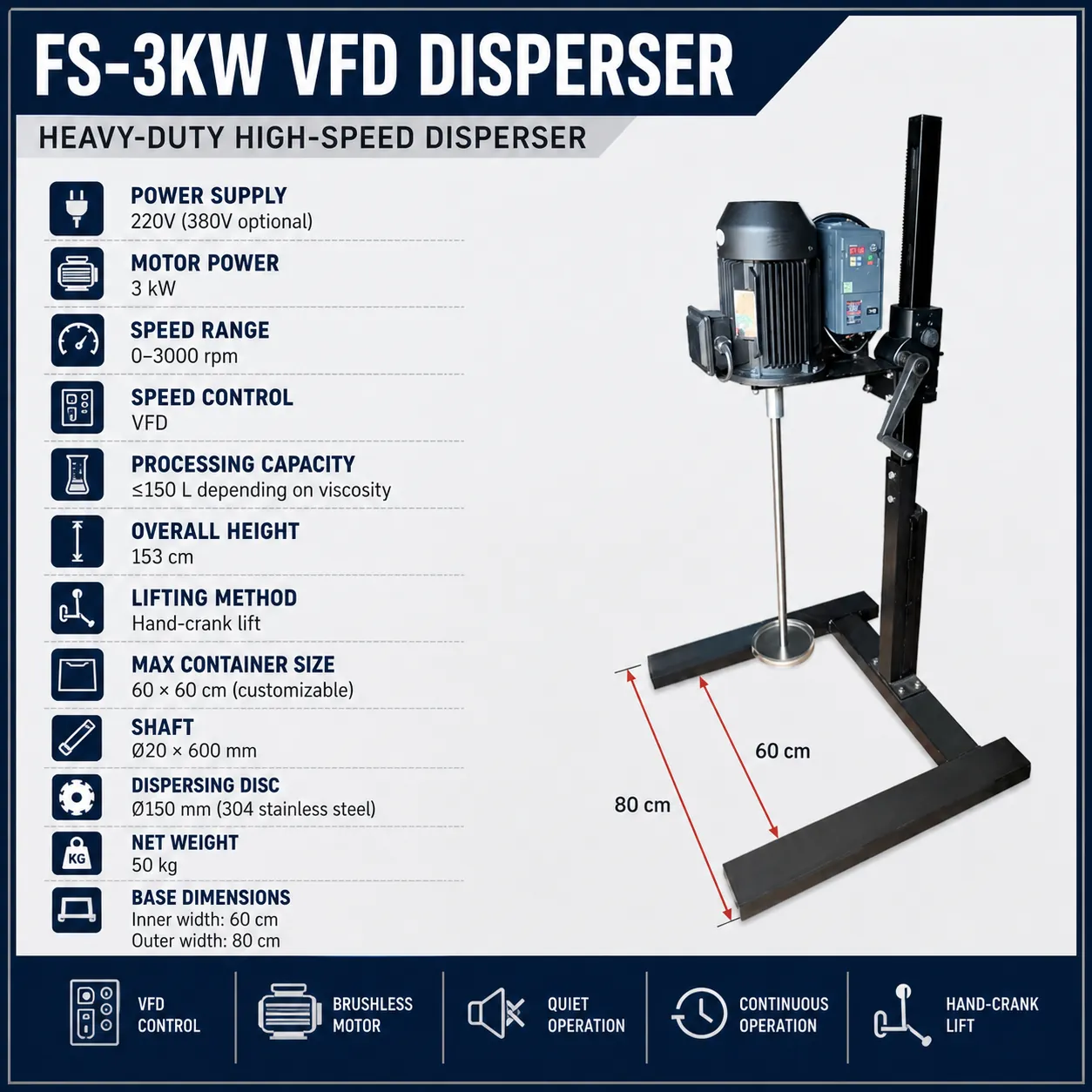
| FS-3KW Variable-Speed | 3 kW, 0-3000 rpm, published capacity up to 150 L subject to process conditions | Small-to-medium production of compatible coatings, inks, resins, adhesives, emulsions, and chemical liquids | The 150 L figure must be confirmed from the real formulation and vessel |
Why Capacity Must Be Confirmed
Two materials with the same volume can place very different loads on the motor. A low-viscosity emulsion and a heavily filled resin paste should not use the same selection rule.
- Viscosity may rise after powder addition.
- High density and solids content increase load.
- A narrow or tall vessel changes circulation.
- Disc diameter changes power demand and tip speed.
- The process may need bulk flow as well as high shear.
Use the liquid viscosity guide if you need help preparing information for model selection.
Materials and Chemical Processes We Can Review
YAKU can review mixing and dispersion configurations for water-based coatings, inks, pigment pastes, resins, adhesives, emulsions, color pastes, compatible chemical slurries, and other liquid or powder-liquid formulations. Suitability is confirmed from the actual material and process data.
Powder into Liquid
Pigments, fillers, colorants, and compatible additives that require wetting and de-agglomeration in a flowable liquid phase.
Liquid Blending and Emulsions
Resin solutions, compatible emulsions, and liquid blends where circulation, shear level, and temperature behavior must be reviewed.
High-Viscosity Materials
Adhesives, filled resins, and pastes that may require a geared drive, anchor movement, or multi-shaft system instead of a standard disperser alone.
A material name is not enough. The same resin or adhesive family can vary widely in viscosity, solids content, temperature sensitivity, and solvent content. Final wetted-part materials and seals must be selected from a compatibility review by the buyer and equipment supplier.
Solvents, Corrosive Materials and Hazardous Areas
A standard chemical disperser must not be assumed suitable for flammable vapor, combustible dust, corrosive service, pressure, or vacuum operation. These conditions require a specific engineering and safety review.
- Provide the safety data sheet and known material compatibility requirements.
- For a classified area, provide the required protection marking, zone or class, gas or dust group, temperature class, and local standard.
- Confirm voltage, phase, frequency, wiring, grounding, ventilation, and site responsibilities.
- Review the motor, controls, switches, wiring, and related electrical parts as a complete system.
- Do not claim a certification or pressure rating unless it is included in the final documented configuration.
See the explosion-proof disperser selection guide for the information required before discussing a solvent application.
How YAKU Reviews a Chemical Mixing Application
1. Define the Material
Share viscosity, density, solids content, powder addition, temperature, solvent information, and available safety data.
2. Define the Batch
Provide minimum and maximum working volume, vessel dimensions, run time, batches per day, and cleaning or changeover needs.
3. Define the Result
State whether the target is powder wet-out, uniform blending, fineness, reduced bubbles, stable temperature, or another measurable result.
4. Review the Configuration
YAKU reviews the equipment type, motor, speed range, lift method, shaft, disc, vessel clearance, voltage, and documented safety requirements.
Depending on the application, shaft length, disc size, vessel clearance, lift arrangement, and electrical supply can be reviewed for customization. The final scope should be confirmed in the quotation and technical drawing.
Chemical Mixing Equipment FAQs
Can one high-speed disperser handle every chemical material?
No. A high-speed disperser is most useful when the batch remains flowable and needs powder wetting or de-agglomeration. Thick materials, fine milling targets, vacuum work, or simple low-shear blending may require another machine.
How do I choose between a disperser and a geared mixer?
Choose from the required flow and shear. A disperser provides higher speed for wetting and dispersion. A geared mixer provides lower-speed torque for materials that are too viscous to circulate around a standard dispersing disc. Some processes require both actions.
Can YAKU confirm suitability from the material name alone?
No. Send approximate viscosity, batch volume, vessel dimensions, solids content, target result, and a material video when available. This information is more useful than the trade name alone.
Is the published maximum capacity guaranteed?
No. Published liters are model references. Actual usable capacity depends on the formulation, vessel, mixing tool, speed, run time, and required result.
Can the machine dimensions or mixing tools be customized?
Shaft length, disc size, vessel clearance, lift arrangement, and other dimensions can be reviewed from the application. Confirm the final dimensions and included parts in the quotation and drawing.
What should I provide for a solvent-based chemical?
Provide the safety data sheet, required hazardous-area classification, protection marking, gas or dust group, temperature class, voltage, phase, frequency, and local standard. Do not order a standard configuration for a classified area without a complete review.
Request a Chemical Mixer Configuration Review
Send your material, viscosity, batch volume, vessel dimensions, target result, voltage, and safety requirements. YAKU will review whether a laboratory disperser, production disperser, vacuum disperser, multi-shaft mixer, or another configuration is the better starting point.