
Vacuum Mixing & De-aeration Equipment
Industrial Vacuum Disperser
Combine high-speed dispersion, vacuum de-aeration and visual process observation for resins, adhesives, coatings and other bubble-sensitive materials.
- Vacuum level up to -0.098 MPa
- Dispersion speed up to 3,000 rpm, model dependent
- Powered lifting for vessel access and cleaning
- Reference working capacities from 1 to 200 L
Disperse and Remove Entrapped Air in One Process
The industrial vacuum disperser creates shear for material dispersion while the sealed vacuum environment helps remove entrapped air from compatible formulations.
Vacuum De-aeration
Helps remove micro-bubbles from viscous materials where air may affect density or surface quality.
High-Speed Dispersion
A saw-tooth blade produces shear for pigment wetting, deagglomeration and uniform mixing.
Powered Lifting
Vertical movement provides convenient access to the vessel and dispersing assembly between batches.
Temperature Control
A jacketed stainless steel vessel can support water or oil circulation for cooling or heating.
Visual Processing Technology
Observe the Process Without Breaking the Vacuum
A high-transparency acrylic observation window lets operators monitor material flow, consistency and bubble removal while the chamber remains sealed.
Visual feedback supports process observation without repeatedly stopping the machine for inspection.
Product Details and Available Configuration
Review the current product below. Final motor power, vessel size and operating parameters should be confirmed according to the material and production requirements.
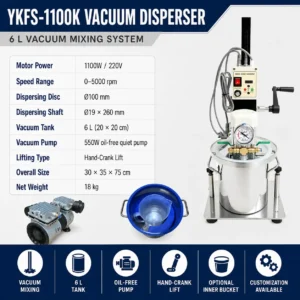
Industrial Vacuum Disperser Specifications
Reference models covering laboratory, pilot and industrial batches. Confirm the final configuration before ordering.
| Model | Power | Working Capacity | Vacuum Degree | Observation Window |
|---|---|---|---|---|
| VDS-PRO-05 | 1.5 kW | 1–5 L | -0.098 MPa | Acrylic visual window |
| VDS-PRO-50 | 7.5 kW | 10–50 L | -0.098 MPa | Acrylic visual window |
| VDS-PRO-200 | 22–30 kW | 50–200 L | -0.098 MPa | Acrylic visual window |
Actual working capacity and performance depend on material properties, formulation, blade selection and operating conditions.
Typical Applications
For compatible, bubble-sensitive liquid and paste processing across formulation, pilot and industrial production.
Coatings & Inks
Dispersion and air removal where surface finish and consistency matter.
Adhesives & Sealants
Processing of compatible viscous formulations prone to entrapped air.
Resins & Polymers
Controlled mixing and de-aeration before subsequent processing.
Chemical Formulations
Flexible batch processing for compatible liquid and paste materials.
How to Select the Right Configuration
Capacity alone does not determine the correct machine. Blade diameter, motor power, speed range, sealing arrangement and vessel design should match the process.
- Define the batch: minimum and maximum working volume.
- Describe the material: name, viscosity, density and temperature sensitivity.
- Set the target: desired fineness, processing time and acceptable bubble level.
- Confirm utilities: voltage, frequency and cooling or heating medium.
Frequently Asked Questions
What does the vacuum system do during dispersion?
The sealed vacuum environment helps draw entrapped air from compatible materials during processing. Results depend on viscosity, formulation, fill level and operating parameters.
Which model should I choose?
Select according to working volume and process demand rather than vessel size alone. Viscosity, target fineness, speed, blade size and temperature control all affect the configuration.
Can the operator see the material under vacuum?
Yes. The acrylic observation window provides a view of material flow and bubble removal while the chamber remains sealed.
Can the vessel be heated or cooled?
A jacketed stainless steel vessel can support water or oil circulation. Include the operating temperature and available utilities when requesting a quote.
Need an Industrial Vacuum Disperser for Your Material?
Tell us your batch volume, viscosity, process target and utilities for an application-based configuration discussion.
Request a Configuration Quote