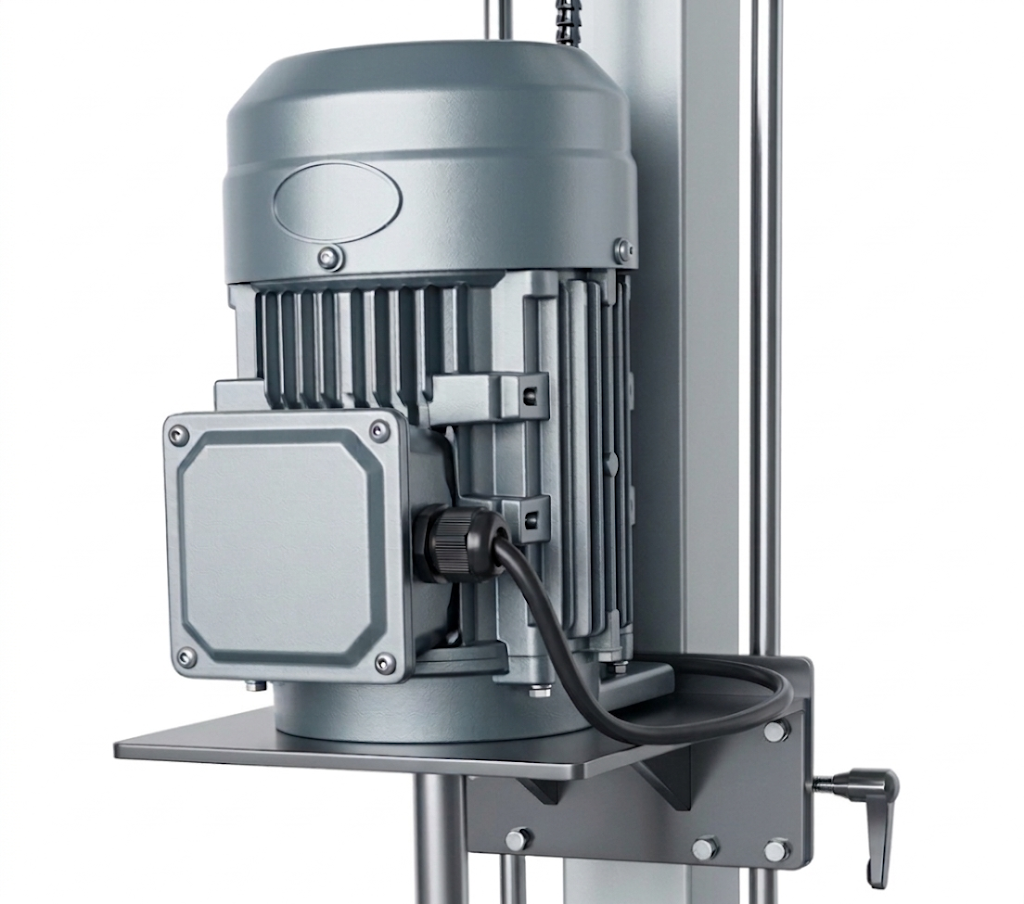
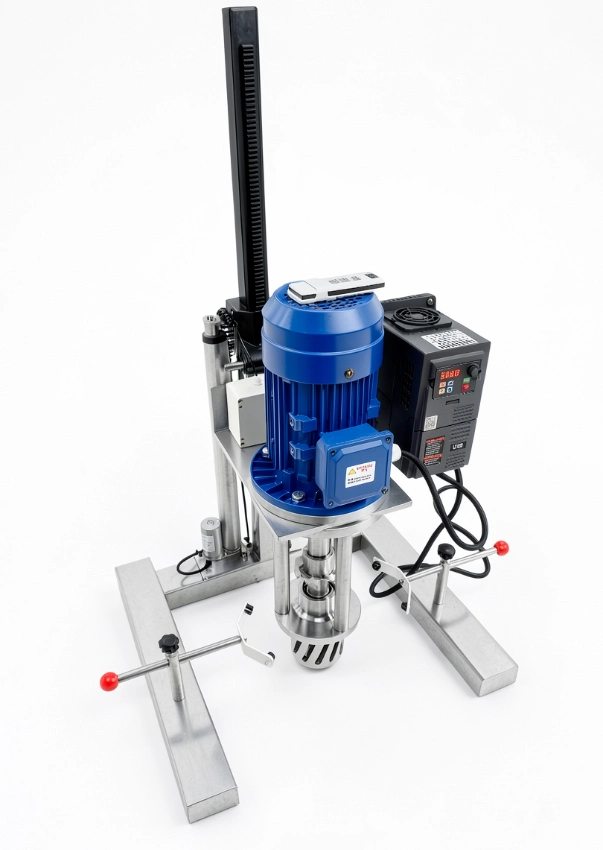
Mixing whey protein powder is not the same as stirring sugar into water. Whey proteins are highly hydrophilic and form tight agglomerates — “fish eyes” — the instant particles touch liquid, trapping dry powder inside a hydrated skin. Reliable, lump-free dispersion needs controlled powder addition, high-shear mixing, and the right tip speed. In production this is typically done with a high-speed disperser; in formulation R&D it starts on a lab disperser.
This guide covers why whey is difficult to disperse, how industrial dispersion differs from simple stirring, the process parameters that actually move the result, and how to choose and scale the right mixer — from bench to batch.
Why whey protein powder is hard to disperse
Whey protein is a surface-active, fast-hydrating powder. Three behaviours cause most mixing failures:
- Instant skin formation. The moment a particle hits water, its outer layer hydrates and gels, sealing the dry core inside. Agitation that is too gentle just rolls these capsules around.
- Agglomeration at the surface. Dumping powder onto a still liquid surface builds a floating raft that slowly hydrates from the bottom up — uneven and lumpy.
- Foam and heat sensitivity. Over-agitation whips air in (foam) and can raise temperature enough to denature protein, hurting solubility and mouthfeel.
The goal is not “stir until smooth.” The goal is to expose every particle to liquid fast, under shear high enough to break skins, without over-aerating or overheating.
Stirring vs. dispersing: the shear matters
| Method | What it does | When it’s enough |
|---|---|---|
| Low-shear paddle / agitator | Moves fluid, mild blending | Pre-blending liquids, not powder dispersion |
| High-shear rotor–stator (dissolver) | Tears agglomerates apart at the tooth disc | Standard for whey reconstitution and emulsified systems |
| Vacuum disperser | Disperses + pulls entrained air out | Foam-sensitive, low-viscosity-to-mid formulations |
| Multi-shaft mixer | Disperses + kneads high-viscosity masses | Thick pastes, high solids loading |
For most whey-based liquids (drinks, concentrates, protein-fortified emulsions), a high-speed disperser with a toothed disc is the workhorse. If your product foams or needs a glossy, air-free finish, move to a vacuum disperser.
The process parameters that decide the result
1. Powder addition rate — Add powder slowly and into the moving vortex, never in a heap onto a static surface. A powder induction lance or a side-entry feed above the disc zone prevents rafting.
2. Tip speed (the number that matters most) — Tip speed predicts dispersion quality far better than rpm alone, because it scales with disc diameter:
Tip speed (m/s) = π × D (m) × RPM / 60
For whey reconstitution, a typical industrial window is 10–25 m/s at the disc edge. Below ~8 m/s you leave agglomerates; far above it you over-aerate and heat the batch.
3. Viscosity and solids loading — Higher protein solids raise viscosity and slow dispersion. Thin the liquid first, disperse into the lower-viscosity phase, then build solids. For very high solids, a multi-shaft mixer carries the load better.
4. Temperature and pH — Whey disperses best in cool-to-warm water (~10–40 °C); very cold slows hydration, very hot risks denaturation. Keep pH in the product’s stable range.
5. Order of addition — Disperse whey into the aqueous phase first, then add fats, gums, and flavors.
A reliable industrial mixing sequence
- Charge and start the base liquid; bring the disc to target tip speed so a stable vortex forms.
- Feed powder slowly into the vortex (induction lance preferred).
- Disperse at 10–25 m/s until no visible agglomerates.
- Deaerate if foaming — vacuum disperser or short vacuum sweep.
- Finish with gentle, low-shear blending.
- Verify viscosity, solubility, denaturation before transfer.
For the full range of dispersion equipment, see our Food & Beverage industry solutions and the high-speed disperser product line.
Choosing the right mixer: lab → production
- Bench and pilot (R&D): A laboratory high-speed disperser lets formulators test tip speed, addition rate, and solids loading on small batches. See research & lab mixer applications.
- Production, low-to-mid viscosity: A high-speed disperser sized to your batch volume and disc diameter.
- Foam-sensitive / air-free finish: An industrial vacuum disperser.
- High solids / thick pastes: A multi-shaft mixer.
- Spare and wear parts: Keep dispersing discs & parts on hand, sized against your tanks & vessels.
Common problems and fixes
| Problem | Likely cause | Fix |
|---|---|---|
| Fish eyes / lumps | Too-fast dump, low tip speed | Slow feed into vortex; raise tip speed to 10–25 m/s |
| Excessive foam | Over-shear, shallow batch | Lower RPM near end; use vacuum disperser |
| Grainy after rest | Under-dispersed solids | Extend dispersion; verify addition order |
| Denatured / off mouthfeel | High temp during mixing | Cool base, shorten high-shear time |
| Sedimentation | Wrong order of addition | Disperse protein before hydrocolloids/fats |
Scaling from lab to production
Treat the lab disperser as your predictor. Lock the tip-speed band, addition rate, and order of addition on a lab disperser, then scale batch size while holding tip speed. Re-verify on pilot before full production. Real examples are in our success stories.
FAQ
How long does it take to disperse whey protein powder? Typically a few minutes of controlled, high-shear feeding plus dispersion — far less than low-shear stirring, which can still leave lumps.
Can you mix whey protein with a regular blender or stirrer? A household blender can break small batches but over-aerates and provides no controlled tip-speed band. For reproducible, scaleable results, use a high-shear disperser.
What tip speed should I use for whey? A common industrial window is 10–25 m/s at the disc edge (π × D × RPM / 60). Validate on a lab disperser for your formula.
Why does my protein mix foam? Over-shearing a shallow batch whips in air. Reduce high-shear time at the end and consider a vacuum disperser.
Need a disperser sized to your batch, viscosity, and solids loading? Request an engineering quote and our team will match the configuration to your material.
Related reading: how to choose a high-speed disperser, vacuum dispersers for foam-sensitive formulations, food & beverage mixing solutions.