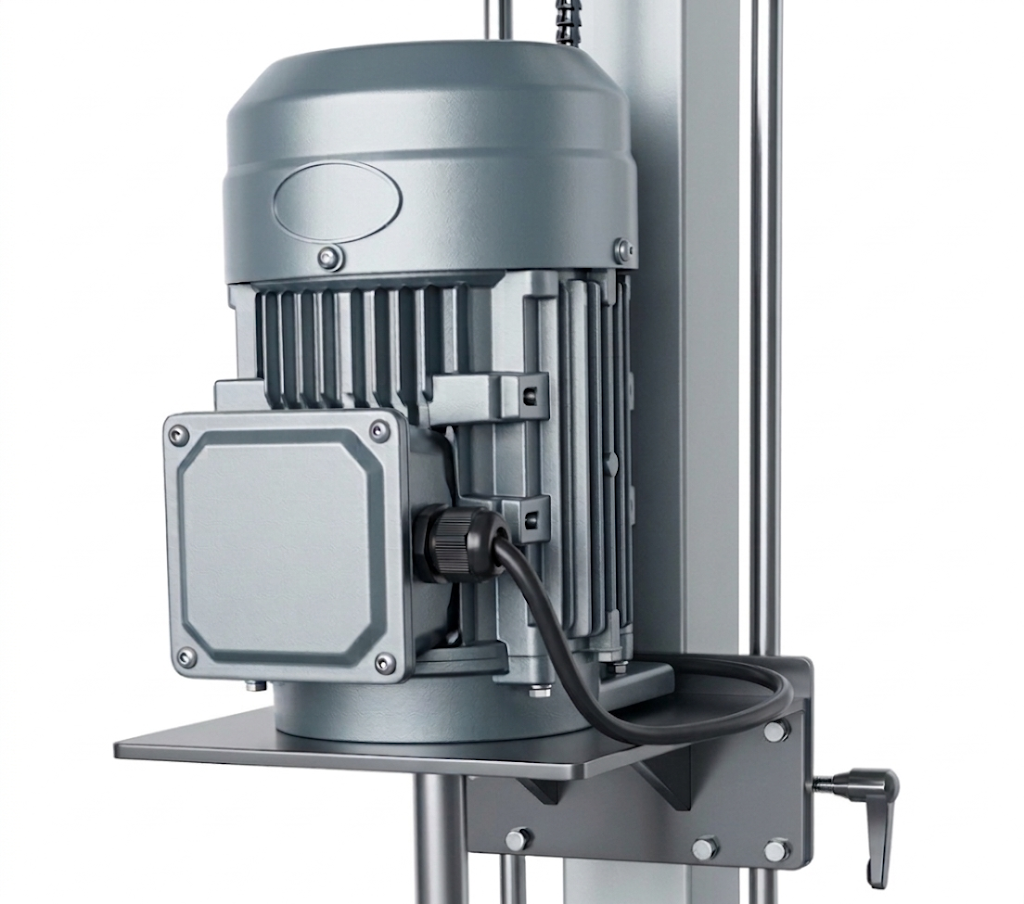
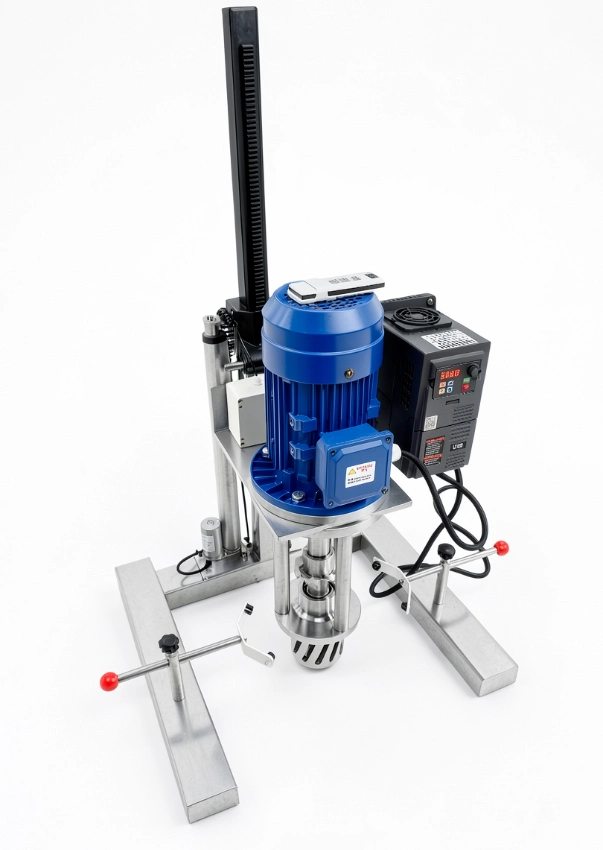
To maximize your production output and unleash the full potential of your industrial mixer, you must answer a few core questions: What actually makes a high-shear dispersion blade efficient? What exactly is a Cowles blade, and when should you use it? Which blade geometry aligns with your specific material viscosity? And if you are running a single industrial mixer for multiple product lines, how do you prevent the operational nightmare of cross-contamination?
If you want to boost shop floor throughput and improve mixing efficiency without breaking the bank, this guide is for you. Let’s dive in.
1. Mythbusting: What is the “Most Efficient” Dispersion Blade?
The hard truth: There is no single “most efficient” dispersion blade in the world. True efficiency means pairing the right blade geometry with your specific chemical process and material properties.
The Efficiency Formula:
$$\text{Maximum Efficiency} = \text{The Right Blade Profile} + \text{Suitable Material Viscosity} + \text{Correct RPM \& Torque}$$
Highly efficient dispersion isn’t just about high-shear force (the ability to rip apart agglomerates and large powder particles). It is equally about batch turnover and circulation—the ability to flip the entire tank, moving material from the top to the bottom without leaving stagnant dead zones.
2. Deep Dive: What is a Cowles Blade (Cowles Disc)?
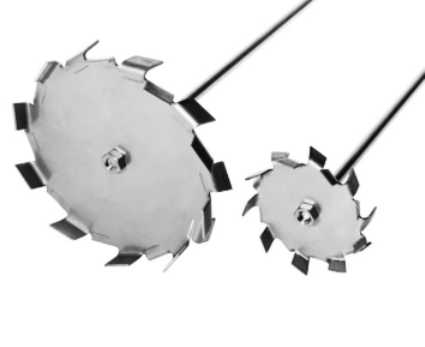
The simple answer: It is the golden industry standard. When someone mentions a high-shear dispersion blade, they are usually picturing a Cowles blade—a flat flywheel disc featuring alternating up-and-down sawtooth edges.
How it Works
When spinning at high speeds, the edge of the Cowles blade generates extreme tip velocities (typically 20-25 m/s or roughly 4,000-5,000 ft/min). This velocity creates immense hydraulic shear and mechanical impact. At the same time, it forms a perfect “doughnut” vortex in your mixing tank, continuously pulling dry powders down into the center to be smashed apart.
- Best For: The vast majority of low-to-medium viscosity paints, inks, chemical coatings, and pigment dispersions.
3. Industrial Dispersion Blade Selection Guide: Types & Applications
Choosing the right blade geometry can make or break your batch. Here is a breakdown of the five most common profiles used to optimize mixing efficiency in an industrial mixer:
1. Standard Sawtooth (Cowles Disc)
- Visual Profile: A flat disc with uniform, alternating up-and-down teeth along the edge.
- Core Function: High shear, medium circulation. It is the ultimate tool for breaking down agglomerated powders and pulling a deep vortex.
- Real-World Application: Run at high RPMs. Perfect for water-based and solvent-based coatings, standard latex paints, and low-to-mid viscosity liquids.
2. Straight-Blade / Flat Paddle
- Visual Profile: Minimalist design, usually featuring a flat, straight bar or paddles with a slight pitch.
- Core Function: Low shear, massive radial flow. Its primary job is gentle blending and keeping solids suspended rather than violent tearing.
- Real-World Application: Best paired with low-to-medium speeds. Use this for shear-sensitive materials (like advanced resins where you cannot break polymer chains) or specialty coatings containing pearlescent or metallic flakes that must remain intact.
3. Dual-Layer Dispersion Disc
- Visual Profile: Two high-shear dispersion blades (typically one large, one small with an adjustable gap) mounted on a single central shaft.
- Core Function: Double the shear, full-tank coverage. The top blade forces light, floating powders down into the liquid, while the bottom blade sweeps up settled solids from the floor of the tank.
- Real-World Application: Run at high speeds. It is the ultimate choice for ultra-light, highly airborne powders (like fumed silica or carbon black) or for very deep, high-capacity mixing tanks where a single Cowles blade cannot pull the vortex down far enough.
4. Butterfly / Tri-Blade Agitator
- Visual Profile: Shaped like a bowtie or butterfly wings, often designed with wide, angled folds pointing up and down.
- Core Function: Low shear, but exceptional macro-kneading and folding capabilities. It processes heavy pastes the way a baker kneads dough.
- Real-World Application: Use at low speeds with high torque. This is your go-to for high-viscosity, clumpy, or paste-like materials. Think heavy adhesives, putties, body fillers, sealants, and high-solids slurries.
5. PTFE (Teflon) Agitator
- Visual Profile: A rugged metal core completely encapsulated in white or semi-transparent PTFE (Teflon). Typically shaped as a straight blade or crescent with an ultra-slick surface.
- Core Function: Supreme chemical resistance and anti-adhesion. It safeguards your process against cross-contamination and is virtually indestructible to aggressive chemicals.
- Real-World Application: Run at low-to-medium speeds. Strictly for highly corrosive materials (strong acids/bases), or ultra-pure electronic and pharmaceutical-grade slurries where metal ion contamination is strictly prohibited. The non-stick property also makes cleanup effortless.
4. The Single Industrial Mixer Dilemma: Eliminating Cross-Contamination
The Pain Point: If you have limited floor space or a tight budget, you likely rely on a single industrial mixer for everything. But if you need to mix white paint today, black ink tomorrow, and a specialty clear coat the next day, cleaning becomes a nightmare. If you suffer a batch-to-batch cross-contamination, you risk losing the entire batch—costing you thousands in wasted raw materials.
Here are 3 proven hacks to solve this and maintain peak mixing efficiency:
- Hack 1: Invest in Quick-Release ShaftsStop wasting 20 minutes fumbling with traditional wrenches. Upgrading your industrial mixer to a quick-release hub or shaft design allows operators to swap an entire dispersion blade assembly in seconds.
- Hack 2: Deploy Dedicated Blades (The Low-Cost Strategy)While the industrial mixer itself is an expensive capital investment, individual dispersion blades are relatively cheap. Buy multiple blades and strictly color-code or categorize them: “Dark Batches Only,” “Light Batches Only,” “Water-Based,” and “Solvent-Based.” Swap the blade when you switch your product line.
- Hack 3: Implement Dynamic Clean-in-Place (CIP)As soon as your batch is pumped out—before the residue dries—lower the Cowles blade into a drum of cleaning solvent or water. Crank the mixer up to high speed for a few minutes. Let the intense hydraulic shear wash the blade and shaft for you automatically.
Quick Reference Guide
| Blade Type | Visual Profile | Core Function | Best For / Real-World Application |
| Standard Sawtooth (Cowles) | Flat disc, alternating up/down teeth | High shear, medium circulation. Excellent for vortex creation. | High RPM. Water/solvent systems, latex paints, mid-viscosity materials. |
| Straight-Blade / Paddle | Simple flat bar or slightly pitched paddle | Low shear, high radial flow. Excellent for suspension. | Low-mid RPM. Shear-sensitive resins, metallic/pearlescent flakes. |
| Dual-Layer Disc | Two discs on one shaft (large & small) | Double shear, full coverage. Eliminates top/bottom dead zones. | High RPM. Light/airborne powders (fumed silica), deep/large-capacity tanks. |
| Butterfly / Tri-Blade | Bowtie/butterfly shape with wide angled edges | Low shear, heavy kneading and folding. | Low RPM, high torque. Putties, adhesives, sealants, heavy pastes. |
| PTFE (Teflon) Agitator | Metal core coated in slick, white Teflon | Extreme chemical resistance, non-stick, zero metal contamination. | Low-mid RPM. Corrosive acids/bases, high-purity electronic or pharma slurries. |
The Bottom Line
Knowing your material’s viscosity and pairing it with the exact right dispersion blade geometry is the secret to getting multi-machine output from a single piece of equipment. Do not let an incorrect setup throttle your mixing efficiency.
What type of dispersion blade are you currently running in your shop? Are you struggling with stubborn agglomerates that just won’t break down, or looking to eliminate cross-contamination on your production line? Reach out to our engineering team today for a free equipment audit and upgrade plan to keep your process running at peak performance!
Knowing your material’s viscosity and pairing it with the exact right blade geometry is the secret to getting multi-machine output from a single piece of equipment. Don’t let an incorrect blade throttle your production.