Table of Contents
Safety isn’t just a checklist; it’s the foundation of professional research. Using non-rated equipment in a hazardous environment can lead to ignition from motor sparks or electrical heat, putting researchers and facilities at extreme risk.
Common Flammable Solvents: The Silent Triggers
Many common laboratory processes involve solvents that have low flash points. A flash point is the lowest temperature at which a liquid gives off enough vapor to ignite in the air. If your project involves any of the following, you definitely need an explosion-proof lab disperser:
- Acetone: Highly volatile with a flash point of approximately -20°C (-4°F).
- Toluene: Widely used in paint thinners and chemical reactions; highly flammable.
- Ethanol & Isopropyl Alcohol: Common in sanitization and extraction, these pose significant vapor risks.
- Hexane: Frequently used in chromatography and oil extraction.
- Xylene: Common in histological applications and industrial synthesis.
When these solvents are agitated or dispersed, they release vapors. A standard motor contains brushes that create micro-sparks—more than enough to ignite a cloud of Acetone vapor.
The Anatomy of a Compliant Explosion-Proof Lab Disperser
At YAKU, we don’t just “add a cover” to a motor. Our explosion-proof lab disperser units are engineered from the ground up to meet rigorous safety standards. True compliance involves two main pillars:
1. The EX-Rated Motor
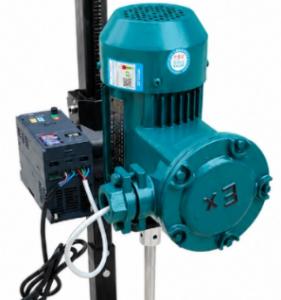
Our motors are housed in flame-proof enclosures designed to contain any internal explosion, preventing it from igniting the surrounding atmosphere. This is the heart of any explosion-proof lab disperser.
2. Professional Electrical Control Boxes
Many manufacturers overlook the controls. We provide specialized explosion-proof control boxes that isolate electrical switching—another common source of sparks—from the hazardous zone. You can explore our full range of safety-first designs at our Product Gallery.
When Do You Need an Explosion-Proof Lab Disperser?
If you are unsure whether your application requires an EX-rated unit, look for these five signs:
- Working in a Classified Zone: If your lab is designated as Class I, Division 1 or 2 (or ATEX Zone 0, 1, or 2), you must use an explosion-proof lab disperser.
- Vapor Accumulation: If you are processing in a small, enclosed space where solvent vapors can reach high concentrations.
- High-Speed Shearing: High-speed dispersion generates heat. If this heat approaches the auto-ignition temperature of your solvent, EX equipment is mandatory.
- Regulatory Compliance: Insurance providers and safety boards (like OSHA) often mandate EX-rated equipment for chemical processing.
- Peace of Mind: Even if not strictly required by law for a specific small volume, many labs opt for an explosion-proof lab disperser to ensure maximum personnel safety.
Choosing the Right Disperser for Your Lab
Selecting equipment involves more than just looking for the “EX” label. You need to balance power, torque, and volume capacity. For a comprehensive breakdown of how to choose the right size and type, check out our guide to selecting medium and small dispersers.
An explosion-proof lab disperser should be a one-time investment in both your productivity and your safety.
Frequently Asked Questions