
Which machine is right for your pigment and paint process?
| Model | Working Volume | Power | Speed | Best For |
|---|---|---|---|---|
| FS-680 | 1–15 L | 0.75 kW | 0-4000 | Lab / small batch |
| FS-1.1 | 5–25 L | 1.1 kW | 0-3000 | Paint / coating |
| FS-1.5 | 10–50 L | 1.5 kW | 0-3000 | Larger batch |
Pick the wrong machine, and you end up with grainy color, wasted pigment, and batches that don’t match. Here’s how paint and coatings manufacturers actually choose the right one.
For most water-based and compatible solvent-based paint formulations, a variable-speed high-speed disperser with a saw-tooth disc is the usual starting point for wetting and de-agglomerating pigments. The correct machine is not selected by tank volume alone. You must also check viscosity, batch size, vessel dimensions, disc diameter, solids content, and the required fineness.
Quick answer: For most paint and coatings manufacturing, a variable-speed high-speed disperser with a saw-tooth disc is the standard machine for wetting and breaking down pigment. It works as long as the batch stays flowable and can circulate around the disc. If the batch is too thick to circulate, or needs finer grinding than dispersion alone can reach, you’ll also need a bead mill, geared mixer, or multi-shaft system.
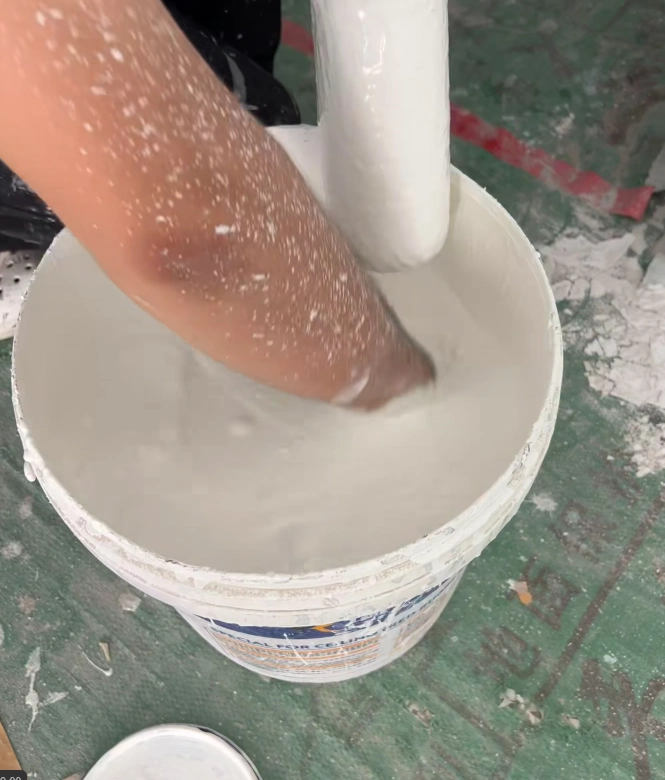
What Machine Is Used to Disperse Pigments in Paint?
A high-speed disperser, also called a high-speed dissolver, uses a rotating disc to move material through the vessel. The flow helps wet dry pigment and break apart loose agglomerates so the particles are distributed through the liquid phase.
This makes a high-speed disperser suitable for many paints, coatings, inks, color pastes, and related formulations. However, it should not be described as a universal grinding machine. Some fineness targets or difficult pigments require a separate bead mill or another milling process after pre-dispersion.
When Is a High-Speed Paint Disperser the Right Choice?
A high-speed disperser is a practical choice when:
- The main task is wetting pigment or filler powder into a liquid.
- The batch can circulate around the disc during operation.
- The formulation is low to medium viscosity, or remains flowable during dispersion.
- You need adjustable speed for charging, wet-out, dispersion, and finishing.
- The required result can be achieved by de-agglomeration without fine milling.
A different configuration may be necessary when the material is so thick that it does not circulate, when heavy powder loading causes the motor to overload, or when the final product requires particle reduction beyond what a dispersing disc can provide. High-viscosity paint may require a geared mixer, an anchor agitator, a multi-shaft system, or a combination of mixing and milling equipment.
Six Details That Determine the Correct Paint Disperser
1. Minimum and Maximum Batch Volume
The vessel may hold 25 L, but that does not mean every 25 L disperser can process a full 25 L batch of your paint. The working volume must leave enough space for safe powder addition and material movement. Minimum batch volume also matters because the disc must remain correctly immersed.
2. Viscosity During the Entire Process
Do not provide only the starting viscosity. Pigment and filler addition can make the batch much thicker. Tell the supplier the approximate starting viscosity, highest expected viscosity, and whether the material becomes thinner or thicker under shear. If you do not have a value, a short material-flow video can help with an initial review.
3. Vessel Diameter and Height
The vessel and disc must work as a system. Vessel diameter affects circulation, while vessel height affects shaft length, lift travel, and working clearance. Send the inside diameter, straight-side height, opening size, and intended working volume.
4. Dispersing Disc Diameter
A disc that is too small may not circulate the batch effectively. A disc that is too large can demand more power and may create excessive movement for the vessel. Final disc selection must consider the vessel, viscosity, speed, motor load, and required flow pattern.
5. Speed and Disc Tip Speed
RPM alone does not describe dispersion intensity because a larger disc has a higher edge speed at the same RPM. Disc tip speed can be calculated as:
Tip speed = 3.1416 x disc diameter x RPM / 60
Use meters for disc diameter to obtain meters per second. The required operating point depends on the formulation, disc design, vessel geometry, temperature limit, and motor load. Maximum speed is not automatically the best setting.
6. Target Result and Test Method
State how you judge completion. This may include a fineness gauge reading, absence of visible agglomerates, color development, viscosity, temperature, or another internal quality check. Without a target, it is difficult to determine whether a disperser alone is sufficient.
YAKU Paint Disperser Capacity Guide
The following figures are published model references, not guaranteed capacities for every paint. Actual usable volume must be reviewed against the formulation and vessel.
| Typical scale | YAKU starting point | Published specification | Best used for |
|---|---|---|---|
| Laboratory samples | YKFS-350 Basic | 350 W, 0-4000 rpm, up to 5 L water reference | Formulation trials and small paint samples |
| Small batch or pilot work | FS-1.1 Electric Lift | 1.1 kW, 0-3000 rpm, published 25 L maximum container capacity | Users who need powered height adjustment and repeat testing |
| Small production | YKFS-1.5 Manual Lift | 1.5 kW, 0-3000 rpm, published capacity up to 50 L depending on viscosity | Flowable paint and coating batches requiring more power |
| Small-to-medium production | FS-3KW | 3 kW, 0-3000 rpm, published capacity up to 150 L subject to process conditions | Larger paint, coating, ink, and pigment batches after configuration review |
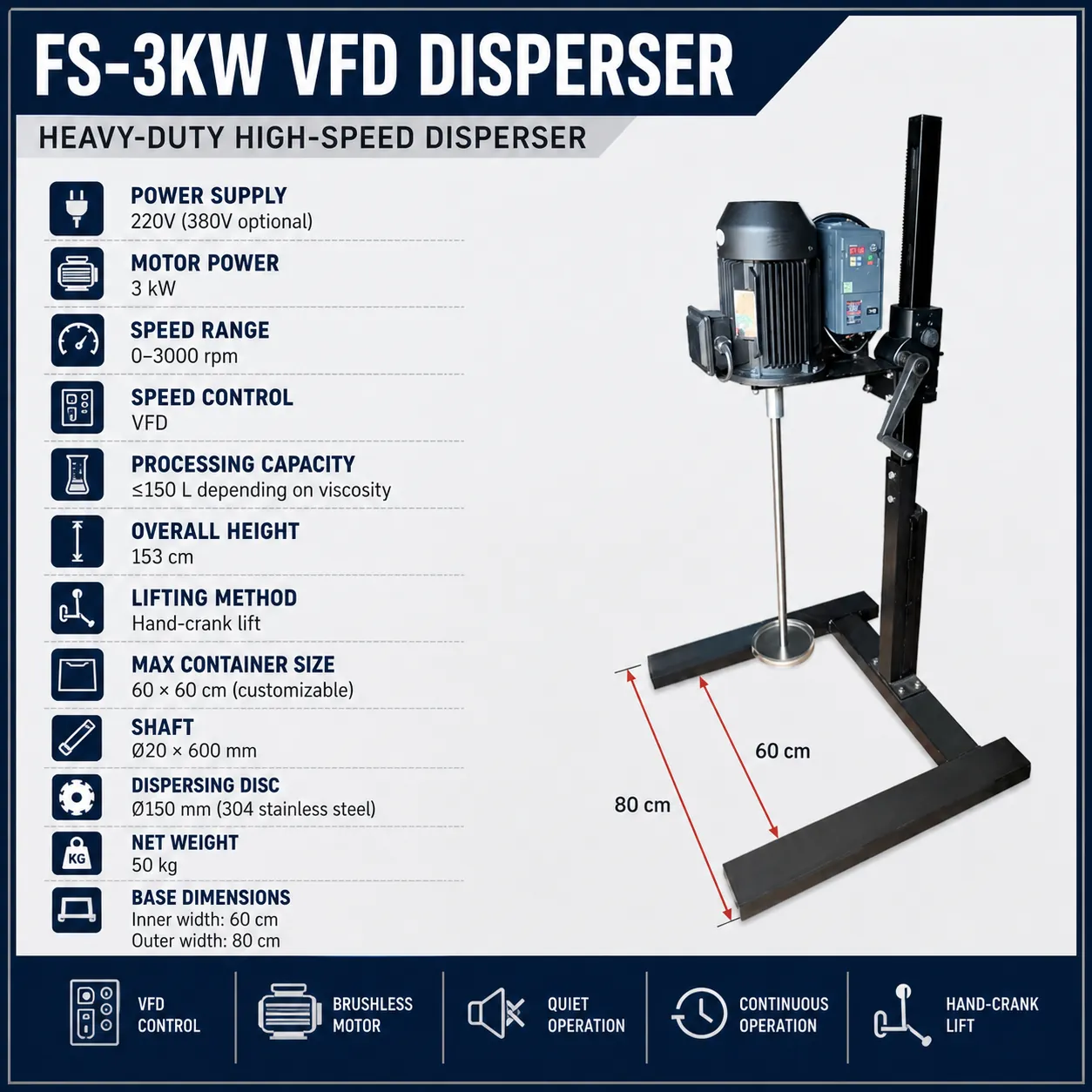
Do Not Choose from Motor Power or Capacity Alone
Two paints with the same volume can create very different loads. A low-viscosity water-based coating and a heavily filled high-viscosity paste should not be treated as the same application. A larger motor also does not correct an unsuitable vessel or disc.
For a useful recommendation, match these elements together:
- Motor power and allowable load
- Working volume and vessel geometry
- Disc diameter, shaft length, and operating position
- Viscosity, density, solids content, and powder addition rate
- Required fineness, temperature limit, and batch time
For additional background, see the small and medium high-speed disperser selection guide, liquid viscosity guide, and dispersing discs and parts.
Special Considerations for Solvent-Based Paint
Do not assume that a standard disperser is suitable for flammable solvent vapor. The complete installation must be reviewed against the site’s hazardous-area classification and local requirements. Provide the required protection marking, gas or dust group, temperature class, voltage, phase, and frequency. The motor, controls, wiring, and related electrical parts must be considered as a complete system.
For this type of application, review the explosion-proof disperser selection guide and confirm the final safety configuration before ordering.
Questions Paint Manufacturers Often Ask
Can one disperser process both water-based and solvent-based paint?
The mechanical process may be similar, but material compatibility, cleaning, contamination control, ventilation, and hazardous-area requirements can be different. Solvent service requires a separate safety review.
Does higher RPM always produce finer paint?
No. Results depend on disc diameter, circulation, viscosity, powder loading, temperature, and run time. Excessive speed can increase splashing, air entrainment, heat, and motor load without solving the actual dispersion problem.
Can a high-speed disperser replace a bead mill?
Not in every formulation. A disperser is effective for wetting and de-agglomeration. If the required fineness cannot be achieved at the pre-dispersion stage, a milling step may still be necessary.
What if my paint becomes too thick to circulate?
Do not select a larger high-speed motor automatically. The process may require a geared low-speed mixer, anchor agitator, multi-shaft mixer, different addition sequence, or another vessel and disc configuration. YAKU can review the options from your actual material information.
Send YAKU Your Paint Process Details
To select the best machine for dispersing pigments in your paint process, send us the material type, starting and maximum viscosity, solids content, minimum and maximum batch volume, vessel dimensions, required fineness, voltage, and daily operating time. A photo or short video of the material flow is also useful when viscosity data is unavailable.
nice topic