
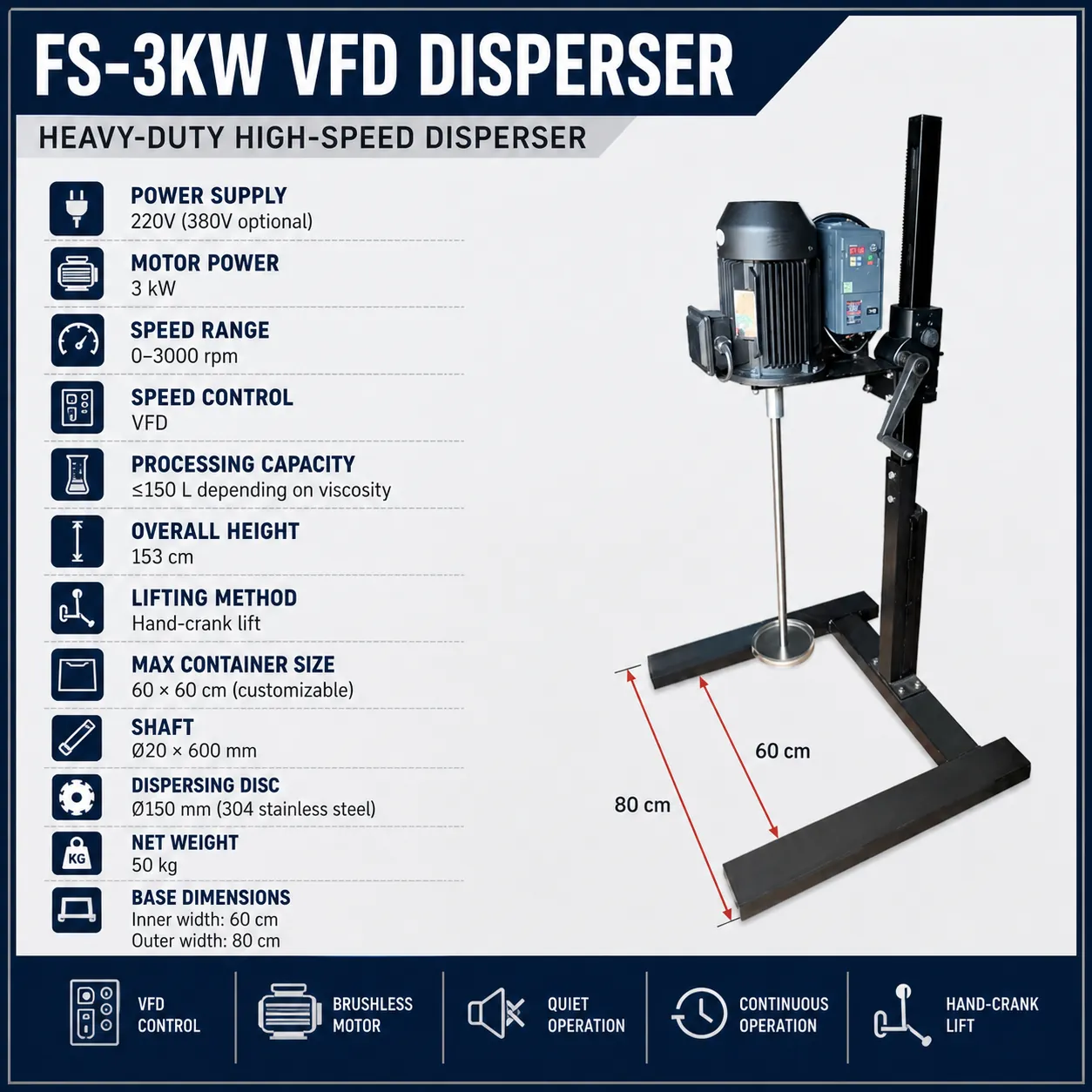
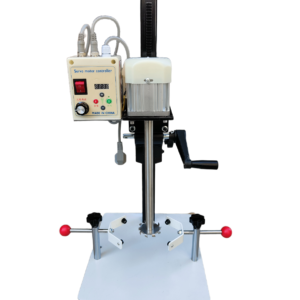
The FS-3KW 3 kW high-speed disperser is designed for adjustable-speed dispersion and mixing in pilot work and small-to-medium batch production. It combines a 3 kW drive, 0 to 3000 rpm VFD speed control, a manual crank lift, and a floor-standing open-frame design.
The published capacity is up to 150 L, but this is a model reference rather than a guarantee for every material. The usable batch must be checked against viscosity, density, solids content, vessel dimensions, disc diameter, operating speed, and required result.
FS-3KW Key Features
- 3 kW motor: provides the drive for the standard FS-3KW configuration.
- Variable speed: VFD control with a published range of 0 to 3000 rpm.
- Manual crank lift: raises and lowers the drive and shaft for vessel access and cleaning.
- 304 stainless steel disc: the published standard disc is 150 mm in diameter.
- Floor-standing frame: open base provides space for a compatible processing vessel.
- Configurable vessel clearance: the published maximum container reference is 60 x 60 cm and can be reviewed for customization.
Technical Specifications
| Model | FS-3KW |
|---|---|
| Motor power | 3 kW |
| Voltage | 220 V; 380 V option shown in the published specification |
| Speed range | 0 to 3000 rpm |
| Speed control | Variable-frequency drive (VFD) |
| Published capacity | Up to 150 L, subject to material viscosity and process conditions |
| Lifting method | Manual crank |
| Overall height | 153 cm |
| Published maximum container reference | 60 x 60 cm; customization can be reviewed |
| Dispersing shaft | 20 x 600 mm |
| Dispersing disc | 150 mm, 304 stainless steel |
| Net weight | 50 kg |
What Can This Variable-Speed Industrial Disperser Process?
The FS-3KW can be reviewed as a starting point for paints, coatings, inks, pigment dispersions, resins, adhesives, emulsions, color pastes, and compatible chemical liquids. Suitability depends on the real formulation and process. A material name alone is not enough for final model selection.
For the best recommendation, provide the viscosity, density, solids content, minimum and maximum batch volume, and vessel dimensions. If viscosity is unknown, see the guide to measuring liquid viscosity.
How to Check the 150 L Reference Capacity
Do not select the machine from the 150 L figure alone. The same volume of two different materials can place very different loads on the motor. Before confirming the capacity, check:
- Material viscosity and density
- Solids content and powder addition rate
- Minimum and maximum working volume
- Vessel inside diameter, height, and opening
- Disc diameter, shaft length, and working position
- Required result and test method
- Run time per batch and batches per day
The standard 150 mm disc and 20 x 600 mm shaft should also be checked against the vessel and material. See the available dispersing discs and parts when reviewing another tool size.
Manual Lift and VFD Speed Control
The manual crank lift allows the operator to position the shaft and disc for a compatible vessel. It can suit users who prefer a simple lift arrangement and do not need frequent powered vessel changes. Confirm the usable clearance and lift position with the intended container.
VFD control allows the operator to adjust shaft speed for charging, powder wet-out, dispersion, and finishing. Maximum RPM is not the only performance measure. Disc diameter, tip speed, circulation, temperature, and motor load must be considered together.
Electrical and Safety Review
The published specification shows 220 V with a 380 V option. Confirm voltage, phase, frequency, wiring method, and local electrical requirements before production.
The standard FS-3KW configuration should not be assumed suitable for a classified hazardous area. If the material contains flammable solvent, provide the required area classification, protection marking, gas or dust group, temperature class, and local standard. The motor, VFD, controls, and related electrical parts must be reviewed as a complete system. See the guide to explosion-proof disperser selection.
Information Needed for a Useful Quote
- Material name and intended application
- Approximate viscosity, density, and solids content
- Minimum and maximum working volume
- Vessel inside diameter and height
- Required dispersion or mixing result
- Run time and batches per day
- Voltage, phase, and frequency
- Hazardous-area requirements, if applicable
- A short video showing material flow or the current process
Frequently Asked Questions
Can the FS-3KW always process 150 L?
No. The published capacity is a reference. Confirm the usable batch from the material viscosity, density, solids, vessel, disc, operating speed, run time, and target result.
Can I order 380 V?
The published specification lists 220 V and a 380 V option. Confirm phase, frequency, wiring, and current availability before the order is finalized.
Can the shaft, disc, or vessel clearance be customized?
Customization can be reviewed from the material, batch volume, vessel dimensions, required working position, and process target. Confirm the final dimensions in the quotation.
Is the standard machine suitable for solvent-based paint?
Do not assume it is suitable. Solvent applications require a formal safety review of the classified area and the complete electrical configuration.
Can the FS-3KW run continuously for 24 hours?
Operating duty must be confirmed from the motor duty class, real load, speed, ambient conditions, cooling, and required maintenance or rest periods. Do not rely on a general 24-hour icon for process approval.
Request an FS-3KW Configuration Review
Send YAKU your material, viscosity, batch volume, vessel dimensions, voltage, run time, and target result. We can review whether the FS-3KW 3 kW high-speed disperser is a suitable starting point or whether another high-speed disperser configuration should be considered.
Reviews
There are no reviews yet.