Finding the right blade disperser speed is the secret to a perfect batch. If you run it too slow, you get clumps. If you run it too fast for too long, you might ruin your material with heat. Most operators ask: “How long should I keep the machine running at its optimum speed?”
The short answer is that it depends on your material. However, for most industrial applications, the “sweet spot” for high-speed dispersion usually lasts between 15 to 30 minutes. In this guide, we will break down exactly how to time your process to get the best results every single time.
Table of Contents
Understanding Blade Disperser Speed
To understand timing, we first need to define blade disperser speed. We aren’t just talking about RPM (rotations per minute). We are talking about “tip speed.” This is the speed at the very edge of the blade. For effective dispersion, you generally want a tip speed of 4,000 to 5,000 feet per minute (fpm).
Once you hit this speed, the “doughnut effect” should form. This is a visual swirl where the material flows down toward the center of the blade and back up the sides of the tank. If you see this, you are at the optimum speed. Now, the clock starts.
Factors Affecting Run Time
Not every liquid reacts the same way to a high-speed blade. Here are the three main things that dictate how long you should stay at high speed:
- Viscosity: Thicker liquids like heavy resins take longer to circulate. Thin liquids like water-based inks disperse very quickly.
- Pigment Hardness: If you are breaking down tough pigments, you might need 20-30 minutes. Soft powders might only need 10 minutes.
- Batch Size: A 5-gallon pail reaches uniformity much faster than a 500-gallon tank.
If you are working with smaller batches, you should check out this guide to selecting medium and small dispersers to ensure your motor can handle the required run time.
The Danger of Over-Mixing
Many people think that running the blade disperser speed at its max for an hour will make the product “extra smooth.” This is a mistake. High-speed dispersion creates friction, and friction creates heat.
If the temperature rises too much, you could face several problems:
- The liquid might thin out too much, causing the “doughnut” to collapse.
- The chemical properties of your resin could change (scorching).
- Solvents might start to evaporate, changing your formula.
Generally, if you haven’t achieved your desired particle size within 30 minutes, increasing the time won’t help. You likely need a different blade design or a more powerful motor.
How to Know When the Mix is Done
Instead of just watching the clock, watch the material. When you reach the optimum blade disperser speed, the mix will look smooth and glossy. You should no longer see “specks” of dry powder on the surface.
Professional operators often use a “Hegman Gauge” to test the grind. This tells you the exact micron size of the particles. Once the gauge shows your target size, stop the machine. Continuing to run it only wastes energy and risks heat damage.
Choosing the Right Disperser for Your Speed
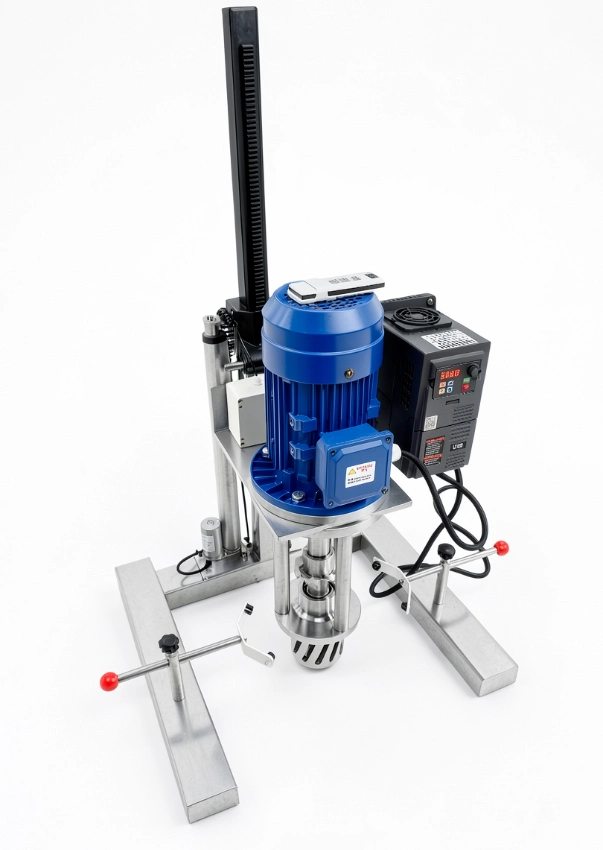
To maintain a consistent blade disperser speed, you need a machine with a reliable Variable Frequency Drive (VFD). A VFD allows you to start slow to avoid splashing and then ramp up to the optimum speed smoothly.
You can find various industrial models designed for these long-run cycles at the Yaku Products page. Having a machine that doesn’t vibrate or overheat during a 30-minute cycle is essential for safety and product quality.
Technical Maintenance for Speed Control
The condition of your blade affects how long you need to run the motor. A worn-down blade loses its “teeth,” which reduces the shear force. If your blades are dull, you will find yourself running the blade disperser speed higher and longer just to get the same result.
Check your equipment weekly. If the edges of the blade feel rounded, replace them. For more deep dives into the mechanics of mixing, visit our Technical Blog.
Frequently Asked Questions (FAQ)
1. What happens if I run the blade too fast?
Excessive speed can pull too much air into the mix (vortexing), leading to bubbles that are hard to remove later. It also causes rapid heat buildup.
2. Can I use the same speed for all materials?
No. Higher viscosity materials usually require lower RPM but higher torque, while low viscosity materials need higher RPM to create shear.
3. How often should I check the temperature?
Every 5 to 10 minutes. If the temperature hits a critical limit for your specific formula, stop the mix or slow down the blade disperser speed.
4. Is the 15-30 minute rule absolute?
No, it is a general guideline. Some lab-scale tests take 5 minutes, while massive industrial batches of tough minerals might take slightly longer.