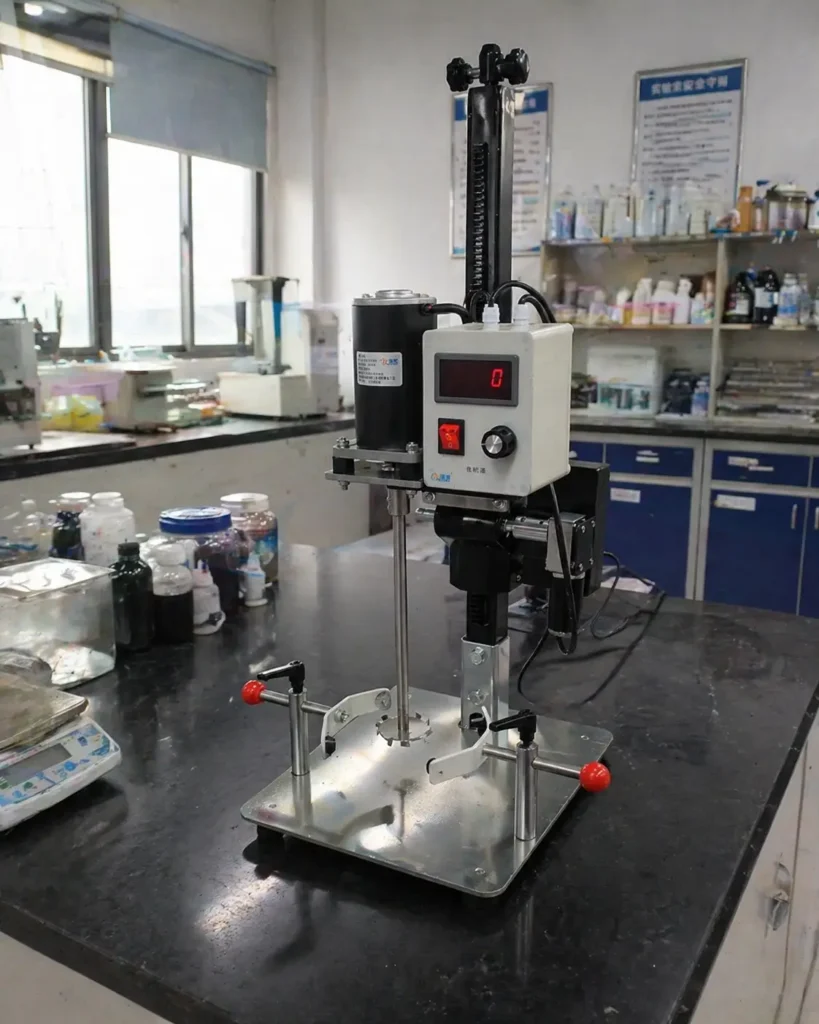
High-speed disperser vs agitator — if you’ve ever stood in front of mixing equipment wondering which one you actually need, you’re not alone. These two machines might look similar at first glance, but they serve very different purposes. Pick the wrong one, and you’ll either waste energy or end up with a poorly mixed batch.
In this guide, we’ll break down the real differences — no fluff, no engineering jargon — so you can make the right call for your specific application.
What Is a High-Speed Disperser?
A high-speed disperser is a mixing machine designed to break down particles and create uniform dispersions. It uses a rotating disc (usually called a Cowles blade) spinning at speeds between 1,000 to 8,000 RPM, depending on the model.
The magic happens at the blade edge. As the disc cuts through the liquid, it creates intense shear forces that tear apart agglomerates — those stubborn clumps of pigment, powder, or solid particles that refuse to dissolve on their own.
You’ll find high-speed dispersers in industries where particle size matters: paints, coatings, inks, cosmetics, battery slurries, and specialty chemicals. They’re the go-to choice when you need to deagglomerate solids and achieve a smooth, homogeneous product.
What Is an Agitator?
An agitator is a broader term for any device that stirs or mixes fluids. It typically operates at lower speeds — usually under 500 RPM — and uses impellers like paddles, propellers, or turbines to create bulk flow within a vessel.
Think of an agitator as a gentle giant. It moves large volumes of liquid around, keeps solids from settling, and maintains temperature uniformity. But it doesn’t have the muscle to break down tough agglomerates.
Agitators are common in water treatment, food processing, pharmaceuticals, and chemical reactors where blending, heat transfer, or maintaining suspension is the main goal.
5 Key Differences Between High-Speed Dispersers and Agitators
1. Speed and Shear Force
This is the big one. A high-speed disperser runs at 1,000–8,000 RPM and generates high shear forces — enough to break apart particle clusters. An agitator typically runs under 500 RPM and produces minimal shear. It moves liquid, but it doesn’t “attack” particles the way a disperser does.
2. Mixing Mechanism
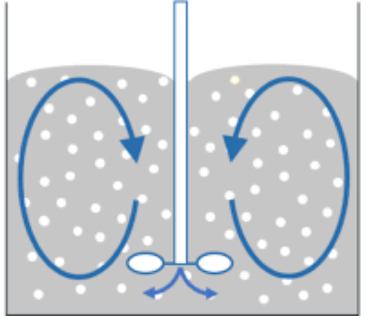
Agitators create bulk flow — the entire contents of the vessel circulate in a predictable pattern. Great for blending, heat transfer, and keeping things in suspension.
High-speed dispersers create localized high-shear zones right at the blade edge. Particles passing through this zone get torn apart. The rest of the vessel might have relatively low flow, but that’s fine because the dispersion happens at the blade.
3. Particle Size Reduction
Need to reduce particle size or break up agglomerates? That’s disperser territory. An agitator can keep particles suspended, but it won’t make them smaller. If you’re trying to disperse titanium dioxide into a paint base, an agitator will leave you with grit. A high-speed disperser will give you a smooth finish.
4. Energy Consumption
High-speed dispersers draw more power per unit volume — all that shear doesn’t come free. Agitators are more energy-efficient for their intended purpose, but trying to use an agitator for dispersion work is actually wasteful because you’ll run it longer and still get poor results.
5. Typical Applications
High-speed dispersers: Paint manufacturing, ink production, cosmetic emulsions, battery electrode slurries, pigment dispersion, adhesive compounding.
Agitators: Water treatment tanks, fermentation vessels, chemical reactors, food mixing, maintaining suspensions, heat transfer applications.
When to Use a High-Speed Disperser
You need a high-speed disperser when:
- You’re dispersing pigments, fillers, or powders into liquids
- Particle deagglomeration is critical to product quality
- You need to achieve a specific particle size distribution
- Your process involves high-viscosity materials (up to 200,000 cP with the right design)
- Product uniformity directly impacts performance (like battery electrode coatings)
For lab-scale work and small batches, benchtop high-speed dispersers offer the same dispersion quality as production units, just at a smaller scale. You can explore different models and specifications here.
When to Use an Agitator
An agitator is the right choice when:
- You’re blending miscible liquids
- You need to maintain solids in suspension (but not break them down)
- Heat transfer or temperature uniformity is the main objective
- You’re working with low to medium viscosities
- Gentle mixing is required to avoid damaging delicate materials
Quick Comparison Chart
| Feature | High-Speed Disperser | Agitator |
|---|---|---|
| Speed Range | 1,000 – 8,000 RPM | 50 – 500 RPM |
| Shear Force | High | Low |
| Primary Function | Deagglomeration, dispersion | Blending, suspension, heat transfer |
| Particle Size Reduction | Yes | No |
| Viscosity Range | Up to 200,000 cP | Typically under 50,000 cP |
| Energy Use | Higher per unit volume | Lower per unit volume |
| Typical Industries | Paints, coatings, inks, cosmetics, batteries | Water treatment, food, pharma, chemicals |
How to Choose the Right Equipment
Start by asking yourself one question: What does my process actually need to accomplish?
If the answer is “break down particles and create a uniform dispersion,” you need a high-speed disperser. If it’s “keep things mixed, suspend solids, or transfer heat,” an agitator will do the job more efficiently.
Still unsure? Consider your material. Powders that tend to clump, pigments that form agglomerates, or high-viscosity formulations almost always require the shear action of a disperser. Clear liquids, suspensions that just need to stay suspended, or temperature-sensitive reactions are better served by an agitator.
For a deeper dive into selecting the right disperser size and specifications for your application, check out this guide to selecting medium and small dispersers.
Frequently Asked Questions
Can I use an agitator instead of a high-speed disperser?
Not if you need to break down agglomerates or reduce particle size. An agitator will keep particles moving, but it lacks the shear force needed for true dispersion. You’ll end up with a poorly mixed product and wasted time.
Is a high-speed disperser the same as a homogenizer?
They’re related but not identical. A high-speed disperser uses a rotating disc to create shear for breaking up solids. A homogenizer typically forces material through a narrow gap at high pressure to reduce droplet or particle size. For most paint, coating, and cosmetic applications, a high-speed disperser is sufficient and more cost-effective.
What speed should I run a high-speed disperser?
It depends on your material and vessel size. As a starting point, aim for a blade tip speed of 4,000–5,000 feet per minute for pigmented systems. Many modern dispersers have digital speed displays that let you dial in the exact RPM for repeatable results.
Can a high-speed disperser handle high-viscosity materials?
Yes, but you need the right motor power and blade design. Standard lab dispersers handle up to 50,000 cP. Industrial models with higher torque can process materials up to 200,000 cP or more. The key is matching your disperser’s capabilities to your material’s viscosity range.
Do I need explosion-proof equipment?
If you’re working with solvent-based materials, volatile organic compounds, or any flammable substances, yes — an explosion-proof disperser is essential for safety. Standard equipment can create sparks that ignite vapors in hazardous environments.