The wrong blade doesn’t just slow you down — it can leave pockets of unmixed material no matter how long you run. Here’s what a simple viscosity experiment revealed about when to switch blades, and how to get it right every time.
We ran a straightforward test in our lab: the same disperser, the same fill volume, two different blade types — a sawtooth disc and a cowles (three-leaf) disc — across a range of material viscosities. The result was surprisingly clean. Above a certain thickness, the cowles disc pulled ahead every time. Below it, the sawtooth blade was consistently faster. The dividing line? Roughly the consistency of honey.
If you’re choosing a disperser blade based on habit rather than viscosity, you’re probably leaving efficiency on the table. This guide walks you through the science behind that threshold, what each blade actually does inside a vessel, and how to apply this to your own process.
Why Disperser Blade Selection by Viscosity Matters
Most mixing problems aren’t caused by underpowered motors or the wrong RPM. They come down to blade geometry. A blade that works brilliantly at 2,000 cP will stall at 50,000 cP — not because it lacks power, but because the material simply doesn’t flow into the high-shear zone the way it needs to.
Research from the Polymer Innovation Blog confirms that a single-shaft disperser blade produces acceptable flow up to around 50,000 cP. Beyond that, the formulation stagnates near the vessel walls and over-mixes near the blade — a classic sign that the geometry is fighting the material rather than working with it.
The physics splits into two regimes: turbulent flow (which the sawtooth blade excels at generating) and laminar flow (where the layering action of a cowles disc does the real work). The more viscous your fluid, the more that laminar “tearing” action dominates — and the less a high-speed sawtooth vortex can help.
What Each Blade Type Actually Does
The Sawtooth Disperser Blade
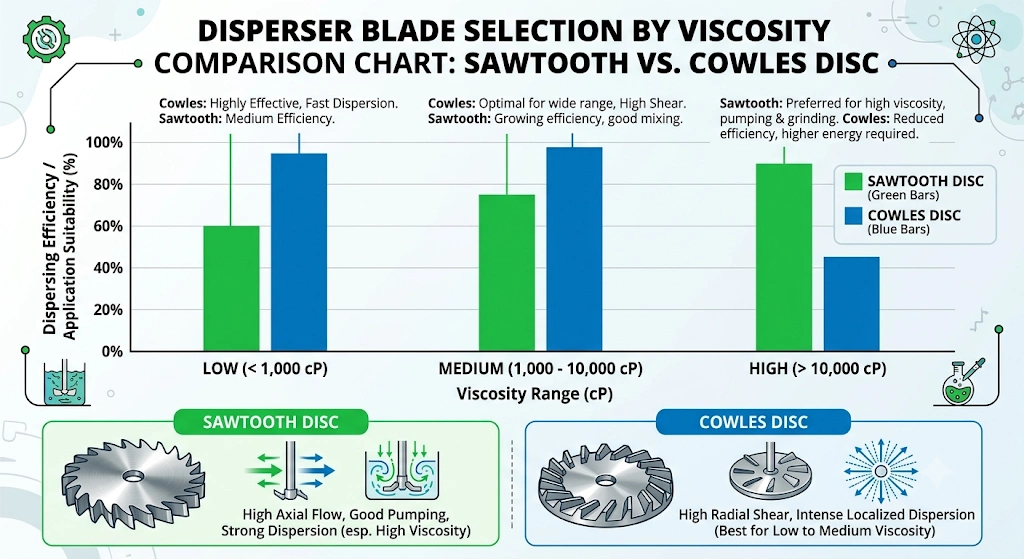
The sawtooth disc has serrated teeth around its perimeter. At high RPM, these teeth generate a strong radial vortex — solids get pulled into the center and thrown outward into the liquid. This is excellent for wetting out powders and breaking down soft agglomerates in thin to medium materials.
Sawtooth dispersers running at tip speeds around 5,000 ft/min create vigorous turbulent flow and are generally used in applications up to around 50,000 cP. At lower viscosities, that turbulence is exactly what you want — the material can actually move.

The Cowles (Three-Leaf) Disc
The cowles disc — sometimes called a three-leaf or anchor disc depending on the configuration — works differently. Rather than throwing material outward via turbulence, it shears it through laminar drag. The blade “tears” layers past each other, and at higher viscosities, that tearing is significantly more effective than any vortex you could generate.
A well-documented principle in mixing science holds that the efficiency of a cowles-type disperser actually increases with increasing viscosity — the opposite of what many operators assume. This is because in thick materials, the smearing and drag mechanism dominates, and that’s exactly what the cowles blade geometry delivers.
The honey rule: If your material is thicker than honey (approximately 10,000–20,000 cP), you’re likely better served by a cowles or three-leaf disc. Below that threshold, a sawtooth blade with its vortex action is usually more efficient.
The Viscosity Threshold: Where the Switch Happens
In our lab test, the performance crossover happened right around the consistency of honey — roughly 10,000 to 20,000 cP depending on solid content. This aligns closely with the literature. Here’s a simplified guide:
| Viscosity Range | Approximate Consistency | Recommended Blade |
|---|---|---|
| Under 5,000 cP | Water to light oil | Sawtooth disc |
| 5,000 – 15,000 cP | Heavy syrup, motor oil | Sawtooth disc (borderline) |
| ~15,000 – 50,000 cP | Honey to thick paste | Cowles / three-leaf disc |
| 50,000 cP+ | Putty, heavy adhesive | Cowles disc + anchor sweep (dual-shaft) |
Above 50,000 cP, even the best single-shaft cowles setup runs into the wall problem: material near the vessel sides simply doesn’t reach the blade. At that point, a dual-shaft setup with an anchor sweep is necessary to keep the whole batch moving.
3 Rules for Smarter Disperser Blade Selection by Viscosity
Rule 1: Match your blade to your material’s flow behavior, not just its thickness
Two materials at 20,000 cP can behave very differently. A thixotropic coating (one that thins under shear) might respond well to a sawtooth blade that generates shear to drop the viscosity. A true high-viscosity paste that stays thick regardless of shear needs the tearing action of a cowles disc from the start. Know your rheology, not just your viscosity number.
Rule 2: Watch your vortex — it tells you if the blade is fighting the material
In a properly matched setup, you should see a stable donut-shaped vortex forming around the blade. If the vortex disappears and the surface goes flat and still, the material is too thick for the blade type in use. That’s when it’s time to switch to a cowles disc — or add a second shaft with a sweep blade if you’re at the upper end of the range.
Rule 3: Blade diameter still matters — don’t ignore the 1/3 vessel rule
Even the right blade underperforms if it’s sized incorrectly. A common guideline is that the blade diameter should be approximately one-third of the vessel’s inner diameter. Going smaller reduces mixing efficiency; going larger increases heat and over-shears the material near the blade while neglecting the outer zones.

Choosing the Right Disperser for Your Application
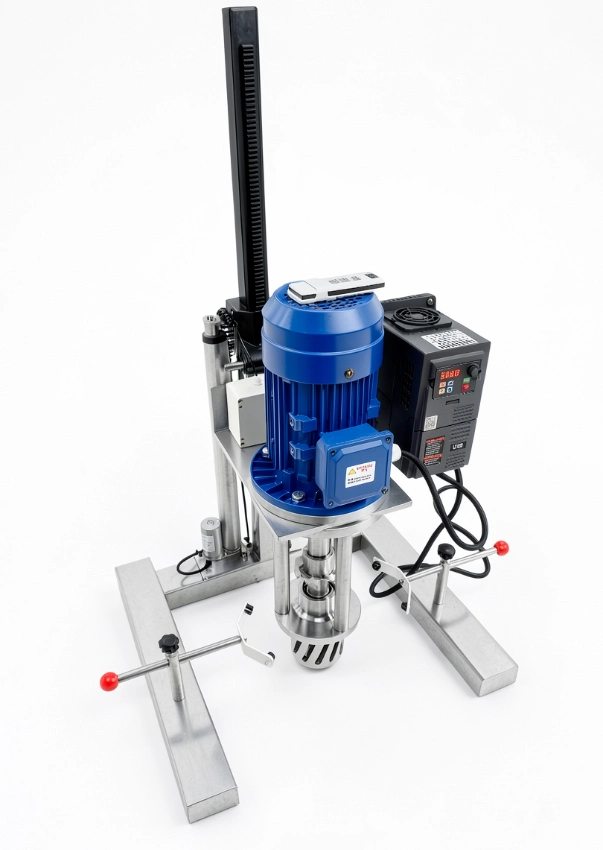
If you’re working across a range of viscosities — common in paint, adhesive, or cosmetics manufacturing — having a single-blade setup forces a compromise. A lab disperser with interchangeable blade shafts, or a vacuum disperser with dual-shaft capability, gives you the flexibility to match the blade to each formulation without buying two separate machines.
Our full range of dispersers is designed with exactly this challenge in mind — from small-batch lab units up to production-scale systems. If you’re not sure which configuration fits your viscosity range, the Yaku Mixer engineering team is happy to work through the specifics with you.
For a broader look at disperser options, the Yaku Mixer blog covers everything from blade geometry to RPM optimization.
Quick Recap
- Sawtooth blades are best below ~10,000–15,000 cP — turbulent vortex action wets solids and disperses agglomerates efficiently.
- Cowles/three-leaf discs take over above that range — their laminar tearing action actually gets more effective as viscosity rises.
- The practical dividing line is roughly honey-like consistency.
- Above 50,000 cP, add an anchor sweep on a second shaft to keep material flowing to the blade.
- Blade diameter should be about 1/3 of the vessel diameter, regardless of blade type.
Frequently Asked Questions
What is the best disperser blade for high viscosity mixing?
For high viscosity materials above roughly 15,000 cP (about honey consistency), a cowles or three-leaf disc is generally the better choice. These blades work through laminar shear — a tearing action that becomes more efficient, not less, as viscosity increases. Below that threshold, a sawtooth disc is typically faster due to its vortex-generating geometry.
How do I know if my disperser blade is wrong for my viscosity?
The clearest sign is a flat batch surface with no visible vortex around the blade. In a properly matched setup, you should see a stable donut-shaped vortex. If the material stagnates near the vessel walls while the area around the blade is over-mixed, your viscosity has likely exceeded what that blade type can handle.
What viscosity range does a sawtooth disperser blade work for?
Sawtooth disperser blades are generally effective up to around 50,000 cP on a single-shaft disperser, but they’re most efficient below 10,000–15,000 cP where turbulent vortex flow can develop freely. Above that range, a cowles-type blade is often the better option.
What blade size should I use relative to my vessel?
A widely used rule of thumb is that the disperser blade diameter should be approximately one-third of the inner diameter of the mixing vessel. A blade that’s too small generates insufficient shear across the batch; one that’s too large creates excessive heat and uneven mixing.
When do I need a dual-shaft disperser?
Once viscosity exceeds roughly 50,000 cP, material near the vessel walls typically stops flowing toward the disperser blade. A dual-shaft setup — with a high-speed cowles disc on one shaft and a low-speed anchor or sweep blade on the other — keeps the entire batch circulating and eliminates stagnant zones. This setup also enables vacuum degassing during dispersion.
References
- Liles, D. (2019). Dispersion of Highly Filled Thermosets – Part Two: Single Shaft Dispersers. Polymer Innovation Blog. polymerinnovationblog.com
- Liles, D. (2019). Dispersion of Highly Filled Thermosets – Part Three: Multi-Shaft Mixers. Polymer Innovation Blog. polymerinnovationblog.com
- Mixers.com. High Speed Mixing: Saw-tooth Dispersers vs. Rotor/Stator Mixers. mixers.com
- Dispersetech. Dispersion Blade Designs. dispersetech.com
- Myers Mixers. Disperser Blades. myersmixers.com
- Wikipedia. High Viscosity Mixer. wikipedia.org