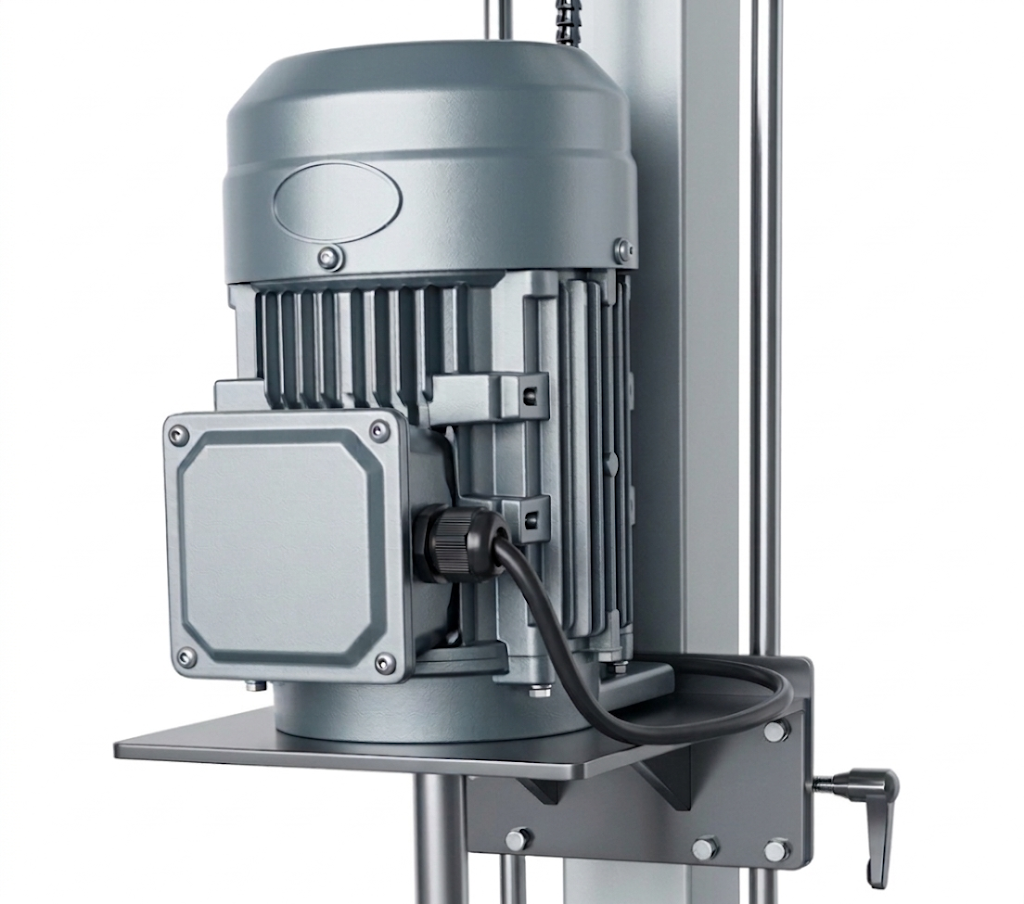
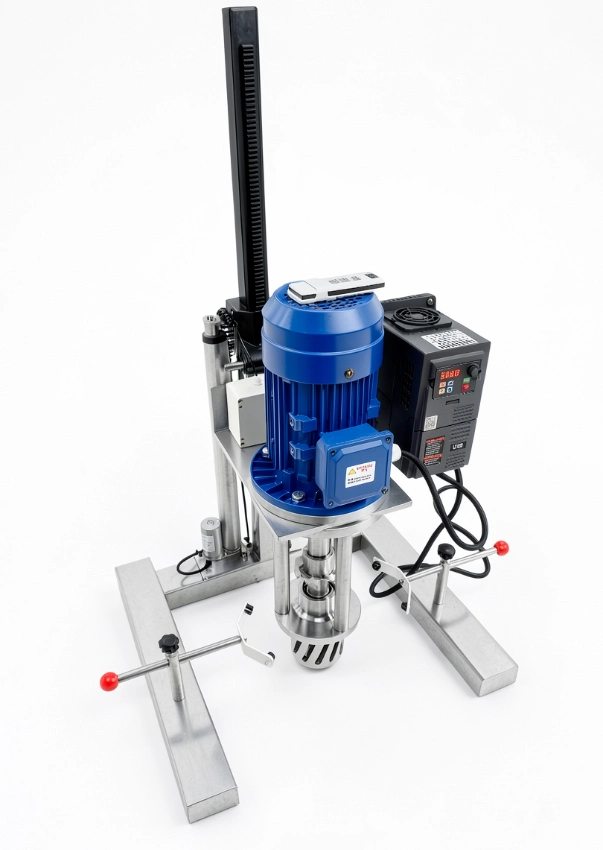
Three machines do almost all of the wet grinding work in paint, ink, adhesive, and battery plants: the high speed disperser, the sand mill (also called a bead mill), and the three roll mill. They look nothing alike, cost wildly different amounts, and solve different problems. The high speed disperser vs sand mill decision is the most common, but you also need to know when a three roll mill is the only answer.
Below are seven rules we use in our own lab when a customer sends us a sample. They are short, opinionated, and based on real numbers. If you are weighing a high speed disperser vs sand mill for a new line, or trying to figure out whether to add a third machine to an existing setup, start here.
If you want to see the equipment side by side, browse our high speed disperser catalog first — every model below $3,300 is in stock at our Zhengzhou shop.
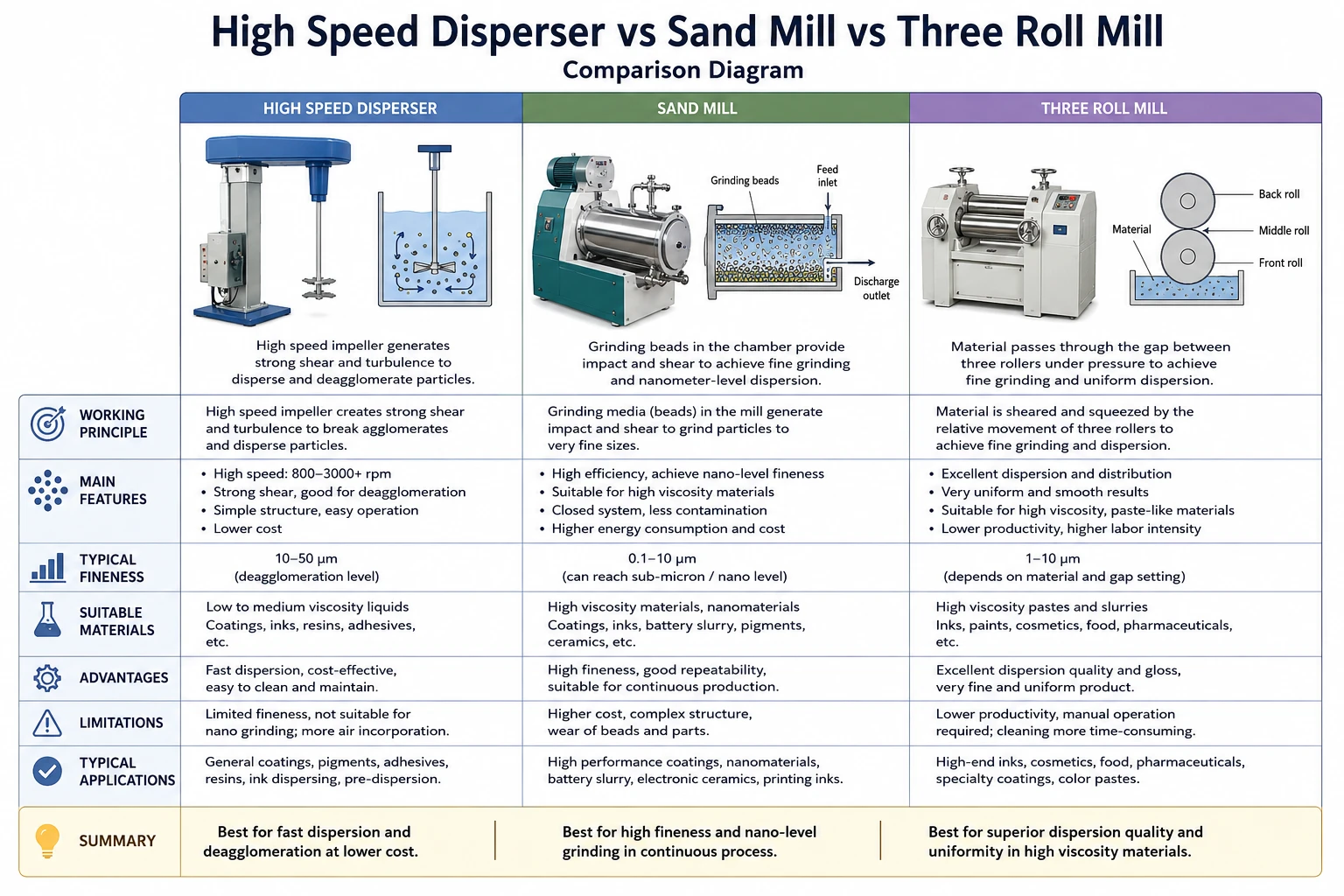
What Each Machine Actually Does
Most confusion starts here. People treat these three as substitutes. They are not. They sit on a process line and do three different jobs, in order.
High speed disperser — the workhorse that breaks up clumps
A high speed disperser is a single shaft with a toothed disc (often called a Cowles blade) spinning at 500 to 6,000 rpm inside an open tank. Pigment and resin go in as dry powder and liquid. The blade throws the mix outward, a vortex forms, and the shear between the disc and the surrounding fluid pulls clumps apart.
Typical outcome: dry powder is wetted out, agglomerates are broken, and the mix is uniform down to about 10 to 25 microns. That covers most architectural paints, battery anode slurries, and general chemical premixing. Our lab disperser line starts at $689 for a 350 W unit, which is the most common R&D entry point.
Sand mill (bead mill) — the fine grinder that takes particles from 25 μm down to 1-5 μm
A sand mill is a horizontal or vertical chamber filled with zirconia or glass beads 0.3 to 2.0 mm in size. A pump pushes your premixed slurry from a feed tank through the chamber at high speed. The beads do the actual work — colliding with each other and with pigment particles. Output particle size: 1 to 10 microns for most coatings, down to sub-micron for nano applications.
This is the machine the formulator in Ohio should have bought second, not first.
Three roll mill — the precision finisher for pastes and high-gloss inks
A three roll mill has three hardened steel or ceramic rollers spinning at different speeds in opposite directions. Material is fed between the first two rollers, the gap gets smaller at each stage, and the shear between the rollers crushes particles to 1 to 5 microns with very tight distribution. Three roll mills dominate in silver paste, carbon black dispersion, and offset printing ink where gloss and conductivity are non-negotiable.
The Real Difference: Particle Size, Viscosity, and Cost
Before you read the rules, look at the numbers. Most buying decisions collapse to four questions: how fine, how thick, how much, and how clean. The high speed disperser vs sand mill choice is usually decided by the first two.
| Equipment | Starting particle size | Final particle size | Viscosity range (cP) | Typical power | Investment level |
|---|---|---|---|---|---|
| High speed disperser | 50–100 μm agglomerates | 10–25 μm | 1,000–50,000 | 0.4–75 kW | $ |
| Sand mill / bead mill | 25–50 μm premix | 1–10 μm | 50–10,000 | 1.5–90 kW | $$$ |
| Three roll mill | 50–200 μm paste | 1–5 μm | 1,000–100,000+ | 0.4–30 kW | $$$ |
Two things jump out. First, the high speed disperser runs at the highest viscosity and the lowest cost, but stops at 10 microns. Second, the sand mill needs a premix that is already under 50 microns, which is exactly what a disperser produces. For quality control, particle size in coatings is measured on a Hegman gauge per ASTM D1210; 10 microns is roughly Hegman 4, while 1 micron is Hegman 8.
Rule 1: Start With the Disperser, Not the Sand Mill
If your raw pigment comes in as a dry powder, do not feed it directly to a sand mill. The beads will clog, the mill will overheat, and you will throw away the first two batches. Run the disperser first, hit 10 to 25 microns, then pump that premix into the sand mill. This is not a marketing line — it is what every paint factory does, and the order is non-negotiable for water-based systems. Our vacuum disperser line handles this premix step without pulling air into the batch.
Rule 2: Match Viscosity, Not Just Particle Size
Particle size gets all the attention, but viscosity decides which machine can even turn on. Above 50,000 cP, a sand mill cannot pump the slurry through its chamber — the rotor stalls. High viscosity pastes (silicone sealant, hot-melt adhesive, solder paste) need either a three roll mill or a planetary mixer. Below 1,000 cP, sand mills work, but so does a high speed disperser with a sawtooth blade running at 5,000 feet per minute tip speed. For a side-by-side look at machine geometry, see our multi-shaft mixer range, which handles up to 100,000 cP.
Rule 3: Three Roll Mill Wins on Gloss
If you are making offset printing ink, conductive silver paste, or a cosmetic pigment dispersion where gloss at 60° needs to clear 90 GU on a BYK haze-gloss meter, a sand mill usually will not get you there. Three roll mills produce a tighter particle size distribution and sheared, not just crushed, pigment surfaces. The trade-off is batch size: a lab three roll mill makes roughly 0.5 to 5 L per hour, while a 30 kW industrial mill tops out at 500 L per hour. For higher throughput with similar fineness, look at basket mills — but that is a different article.
Rule 4: Sand Mills Need a Pump and a Loop
A sand mill is not a standalone machine. It is one part of a loop: feed tank, pump, mill, screen, return to tank. That loop is roughly twice the floor space of the mill itself, and it is also where cleaning time lives. A high speed disperser in an open tank can be wiped out and color-changed in 15 minutes. A sand mill with 200 kg of zirconia beads inside needs a full flush, a bead wash, and sometimes a bead dump. If you run more than three colors per shift, this rule alone will pick your equipment.
Rule 5: Pilot Testing Saves Six Figures
The mistake we see most often is scaling up from a 5-liter lab test to a 2,000-liter production batch by linear extrapolation. Mixing does not scale linearly — power scales with the cube of impeller diameter, so doubling your batch size requires roughly five times the horsepower, not two. The TAPPI pigment dispersion primer has a useful table on scale-up constants. The shortest path: send us a 5 kg sample, we run it on our dispersing discs at lab scale, and we tell you the production-machine model that matches the lab data.
Rule 6: Don’t Skip the Pre-Mix Step
Even when a sand mill is the only finishing machine you own, the pre-mix step is not optional. Powder dumped directly into a sand mill chamber forms dry pockets, floats on the surface, and never gets wet. Run your disperser for 10 to 15 minutes first — long enough for the vortex to fully wet every pigment particle — before you turn on the mill’s pump. Skipping this step is the most common reason for “the mill is not grinding fine enough” complaints in our service inbox.
Rule 7: Buy Equipment From a Source Factory, Not a Trader
The cheapest quote is rarely from the factory. It is usually from a trading company in the same industrial park, reselling another factory’s machine with a 15 to 30 percent markup and no service team. A source factory gives you CE documentation that actually matches the serial number, a parts list you can reorder from in five years, and an engineer who answers the phone. We have been building high speed dispersers in Zhengzhou for over a decade, and our oldest running units in the field are past year eight.
Putting It Together
The high speed disperser vs sand mill question almost always has the same answer: you need both, and in that order. The disperser does the wetting and deagglomeration. The sand mill does the fine grinding. The three roll mill steps in only when gloss, conductivity, or sub-5-micron precision is the actual product spec.
Send us a 1 to 5 kg sample of your formula and a target Hegman reading. We will run it on our lab line and recommend the exact production model. The full catalog is at yakumixer.com/products — pick a starting point and we will take it from there.
FAQ
Can a high speed disperser replace a sand mill?
No. A high speed disperser stops around 10 to 25 microns. For sub-10-micron finishes in paint, ink, and battery slurries you still need a sand mill or a three roll mill downstream.
What particle size can a high speed disperser achieve?
Most pigments end up at 10 to 25 microns after a properly run disperser batch, which is roughly Hegman 4 to 6. Going finer requires the mechanical action of grinding media.
What is the difference between a sand mill and a bead mill?
They are the same machine. “Sand mill” is the older term from when manufacturers used natural sand as the grinding media. “Bead mill” is the modern term for mills using engineered zirconia or glass beads.
Is a sand mill more expensive than a disperser?
Yes. A lab high speed disperser starts around $700; a lab sand mill starts around $5,000. Industrial sand mills with pumps, tanks, and screens commonly run 3 to 10 times the price of an equivalent disperser.
Do I need both a disperser and a sand mill?
For most water-based and solvent-based coatings, yes. The disperser handles premix and color development, and the sand mill handles final particle size. Skipping the disperser step is the single most common cause of sand mill problems in new factories.
References
- ASTM D1210-21 — Standard Test Method for Fineness of Dispersion of Pigment-Vehicle Systems by Hegman-Type Gage. https://www.astm.org/d1210-21.html
- BYK-Gardner — Fineness of Dispersion: Hegman Gage. https://www.byk.com/en/instruments/products/fineness-of-dispersion-hegman.html
- TAPPI — Pigment Dispersion Fundamentals. https://www.tappi.org/