Quick Answer
To mix xanthan gum without lumps, prevent the powder from entering the liquid in dense clumps. Depending on your formulation, you can dry-blend it with compatible powders, pre-disperse it in an oil phase or sugar solution, or feed it gradually into an established vortex using suitable shear.
After the powder has been dispersed, continue mixing until the liquid is uniform and the viscosity has stabilized. The correct procedure depends on the xanthan grade, concentration, batch volume, temperature and mixing equipment.
Xanthan gum is widely used to thicken, suspend and stabilize sauces, dressings, beverages, emulsions and many other liquid products. However, adding the powder incorrectly can produce stubborn agglomerates commonly called fish eyes.
These lumps contain dry powder surrounded by a hydrated outer layer. Once they form, extending the mixing time may not be enough to remove them.
This guide explains why xanthan gum forms lumps, compares three practical dispersion methods and provides a repeatable small-batch mixing procedure.
Why Does Xanthan Gum Form Fish Eyes?
Xanthan gum is soluble in cold or hot water, but the surface of each powder particle begins hydrating as soon as it contacts the liquid. When too much powder is added in one place, the outside hydrates before water can reach the powder inside.
The result is a soft gel layer surrounding a dry center. Low-speed stirring may simply circulate these agglomerates around the vessel instead of breaking them apart.
The risk of lumping normally increases when:
- The powder is dumped into the vessel too quickly.
- The liquid is not circulating before powder addition begins.
- The mixer cannot provide enough circulation for the batch volume.
- The viscosity rises faster than the mixer can move the material.
- The powder accumulates on the surface or vessel wall.
- The selected xanthan grade is difficult to disperse under the available process conditions.
Three Practical Ways to Disperse Xanthan Gum
Method 1: Dry-Blend It With Other Powders
If the formulation contains sugar or another compatible dry ingredient, the xanthan gum can be blended with that ingredient before it enters the liquid.
Separating the xanthan particles reduces the chance that a concentrated mass of gum will contact the water at the same time. The dry blend should still be added gradually into moving liquid.
Method 2: Pre-Disperse It in a Compatible Liquid
If the formulation permits, xanthan gum may be pre-dispersed in a compatible oil phase or sugar solution before water is introduced. This helps separate the particles before hydration begins.
This method is formulation-dependent. Confirm ingredient compatibility, food regulations and the required product label before using a pre-dispersion liquid.
Method 3: Direct Addition Under Controlled Shear
Direct addition is suitable when the mixer can establish strong circulation and disperse the powder before a thick gel layer forms around the particles.
The powder should be introduced in a controlled stream into the active flow zone. Avoid dumping it directly onto the shaft, blade hub, vessel wall or a stagnant part of the liquid surface.
| Method | Best Used When | Main Limitation |
|---|---|---|
| Dry blending | The formula contains compatible powdered ingredients | Requires uniform powder premixing |
| Liquid pre-dispersion | A compatible oil phase or sugar solution is available | May not suit every formulation |
| Direct high-shear addition | Fast, repeatable production is required | Requires suitable circulation and mixer capacity |
How to Mix Xanthan Gum Without Lumps Using Direct Addition
The following procedure is a starting framework for laboratory and small-batch trials. It is not a universal recipe. Validate the final settings using your actual xanthan grade, formulation and equipment.
- Confirm the formulation. Record the xanthan grade, required concentration, liquid temperature, batch volume and target viscosity.
- Charge the main liquid. Add the required liquid phase to a clean vessel. Make sure the blade has sufficient clearance from the vessel bottom and sides.
- Start at a controlled speed. Establish complete circulation before adding powder. The liquid should move throughout the vessel without excessive splashing or air entrainment.
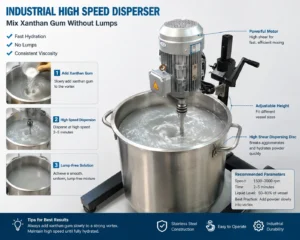
- Add the powder gradually. Feed the xanthan gum in a steady, controlled stream into the active flow zone. Do not dump the entire quantity at once.
- Maintain circulation. Adjust the speed as viscosity increases. Watch for powder collecting on the surface, vessel wall or mixer shaft.
- Continue mixing after addition. Powder dispersion and complete hydration are not always simultaneous. Continue mixing for the validated process time.
- Inspect and sample. Check the liquid for visible fish eyes, surface powder, foam and inconsistent texture.
- Verify the final viscosity. Measure viscosity using a consistent temperature, spindle, speed and test method. Recheck after the specified hydration or holding period.
Important: There is no universal RPM for dispersing xanthan gum. RPM alone does not describe the actual mixing condition because blade diameter, vessel geometry, batch volume, viscosity and motor power all affect performance.
Use the equipment manufacturer’s validated operating range and confirm the result with a controlled batch test.
Process Variables You Should Record
A repeatable process requires more than recording mixer RPM. During each trial, record the following information:
| Process Variable | Why It Matters |
|---|---|
| Xanthan grade and supplier | Different particle sizes and grades may disperse differently |
| Xanthan concentration | Higher concentration increases viscosity and circulation resistance |
| Batch volume | Affects blade coverage, circulation and required power |
| Starting temperature | Influences product viscosity and hydration behavior |
| Vessel dimensions | Affects the flow pattern and the location of stagnant zones |
| Blade type and diameter | Influences pumping action and shear |
| Powder addition time | Adding too quickly can increase agglomeration |
| Post-addition mixing time | Allows dispersion and hydration to continue |
| Final viscosity test method | Makes results comparable between batches |
Xanthan Gum Mixing Troubleshooting
| Problem | Possible Cause | Corrective Action |
|---|---|---|
| Large fish eyes | Powder was added too quickly | Reduce the addition rate and improve powder distribution |
| Powder floating on the surface | Weak surface movement or poor feed location | Establish circulation before feeding and move the feed point |
| Powder collecting on the wall | Vessel circulation is incomplete | Review blade position, vessel geometry and batch level |
| Too much foam | Excessive vortex or air entrainment | Reduce unnecessary surface drawdown and review blade depth |
| Viscosity lower than expected | Incomplete hydration, incorrect dosage or test variation | Confirm weighing, mixing time and viscosity test conditions |
| Viscosity continues rising during storage | Unhydrated material remained after mixing | Improve initial dispersion and validate the hydration time |
| Mixer overload | Viscosity exceeds the equipment’s operating range | Reduce batch size or select a mixer with suitable torque and power |
Choosing a Mixer for Xanthan Gum Dispersion
The correct mixer cannot be selected from RPM alone. Before choosing equipment, provide the supplier with:
- Minimum and maximum batch volume
- Xanthan concentration and grade
- Starting and final viscosity
- Vessel diameter, height and working level
- Other powders, oils, salts or acids in the formulation
- Temperature and cooling requirements
- Cleaning and sanitation requirements
- Required production time per batch
For help matching batch size, viscosity and lifting method, read our guide to selecting medium and small dispersers.
For food-related production, verify the product-contact material, surface finish, seals, cleaning method and required compliance documentation before ordering equipment. A standard industrial mixer should not automatically be described as sanitary or food-grade.
Frequently Asked Questions
Can xanthan gum be mixed in cold water?
Yes. Xanthan gum is cold-water soluble, but cold-water solubility does not guarantee lump-free addition. Powder distribution, xanthan grade, feed rate and mixer circulation still need to be controlled.
Does hot water prevent xanthan gum lumps?
Not necessarily. Xanthan gum can be processed in hot or cold liquid, but temperature alone does not correct poor powder addition. Use a validated procedure for the specific formulation and xanthan grade.
What is the best RPM for mixing xanthan gum?
There is no single best RPM. The required setting depends on blade diameter, batch size, vessel geometry, xanthan concentration, viscosity and equipment power. Tip speed and actual circulation are more informative than RPM alone.
Can xanthan gum be mixed with sugar before adding it to water?
Yes, when sugar is compatible with the formulation. Dry blending helps separate the xanthan particles, but the mixture should still be added gradually into moving liquid.
Why does the viscosity increase after mixing?
The gum may continue hydrating after the initial mixing stage. Use a consistent holding time and viscosity test method before approving or comparing batches.
Can a high-speed disperser handle xanthan gum?
It may be suitable for certain formulations and batch sizes, but performance depends on circulation, blade design, available torque and the final viscosity. A sample test is recommended before selecting production equipment.
Need Help Selecting a Xanthan Gum Mixer?
Send us your batch volume, xanthan concentration, starting and final viscosity, vessel dimensions and sanitation requirements. YAKU engineers can help review the application and recommend a suitable test configuration.