The paint dispersion process is the foundational cornerstone of successful coating formulation. When creating a laboratory sample—often referred to as “making a small sample”—precision is everything. A minor oversight at this stage can lead to costly batch failures during full-scale manufacturing. Understanding how the paint dispersion process behaves at a small scale allows chemists to ensure color accuracy, gloss consistency, and long-term shelf stability before moving to mass production.
Why the Paint Dispersion Process Determines Sample Accuracy
To master the paint dispersion process, one must understand the underlying science of the dispersion of pigments in paint. Pigments do not dissolve in the liquid medium; instead, they must be uniformly suspended throughout the vehicle. This complex mechanism of dispersion in paint manufacturing involves breaking down tight pigment agglomerates into primary particles, wetting their surfaces with resin, and stabilizing them against re-clumping (flocculation).
Developing a robust pigment dispersion formulation requires a careful balance of resins, solvents, and wetting agents. If the mechanical shear or the chemical balance is off, the paint pigment particle size remains too large. This results in poor hiding power, color shifting, and premature settling of the coating.
Paint Manufacturing Process Step by Step
Replicating an industrial paint manufacturing process flow chart within a laboratory setting requires a disciplined approach. Below is the breakdown of the paint manufacturing process step by step for creating flawless lab samples:
1. Pre-Mixing and Wetting
Before turning on high-speed equipment, liquid components—such as resins, solvents, and additives—are combined. The dry pigment powder is then gradually introduced. This initial paint mixing process ensures that the pigment clusters are completely wetted by the liquid vehicle, replacing trapped air on the particle surfaces with resin solution.
2. High-Speed Dispersing
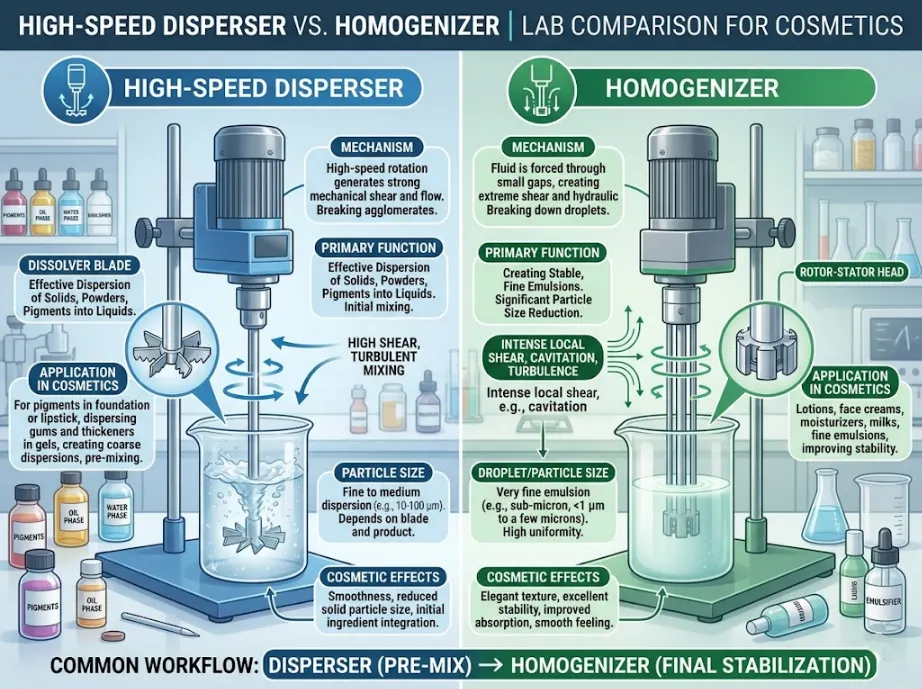
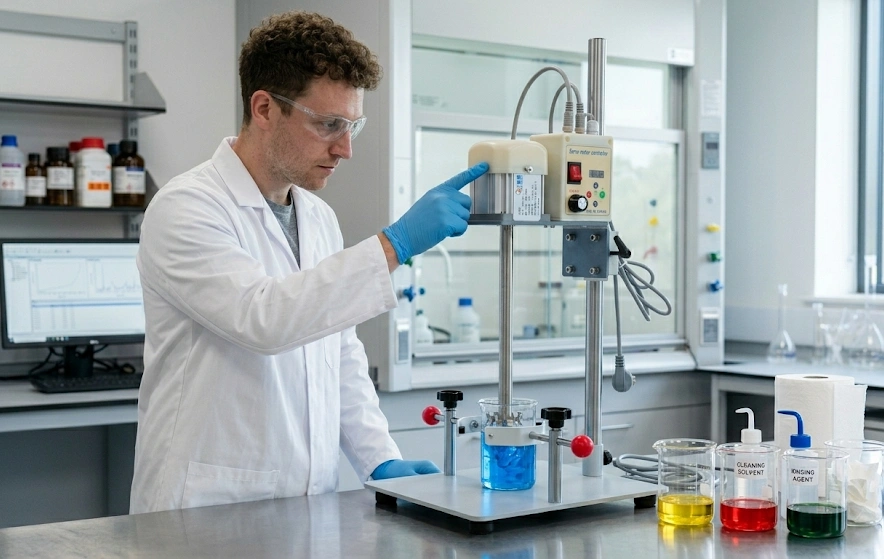
This is where the actual paint dispersion process takes place. The pre-mixed slurry is subjected to intense mechanical shear. Chemists typically use a specialized paint dispersing machine to achieve the necessary velocity. The shear forces generated by the rotating blade tear the pigment clusters apart, drastically reducing the paint particle size to its optimal distribution.
3. Let-Down and Final Stabilization
Once the pigment has reached its target refinement, the remaining portion of the resin, tinting pastes, and slip additives are incorporated. This stage utilizes a gentler paint mixing process to prevent damaging the polymers while ensuring the entire mixture becomes completely homogeneous.
Evaluating Quality: What is the Fineness of Paint?
How do you verify if your laboratory paint dispersion process was successful? The answer lies in checking the fineness paint values. What is the fineness of paint? It is a quantitative measurement of the size and distribution of pigment particles within the finished coating matrix.
To measure this parameter, laboratory technicians rely on a specialized tool called a Hegman gauge. But what does Hegman mean in practical terms? The Hegman scale runs from 0 to 8. A higher Hegman number indicates a smaller paint particle size and a significantly more thorough dispersion. For instance, high-gloss topcoats often require a Hegman reading of 7 or higher, meaning particles must be ground down to under 15 microns.
Choosing the Right Paint Manufacturing Machine for Lab Scale
Standard laboratory stirrers lack the mechanical power required to achieve deep dispersion. To get reliable, reproducible results that match factory production, choosing the correct paint manufacturing machine for your R&D lab is vital.
For standard atmospheric sampling, high-speed lab dispersers offer excellent speed control and torque adjustments to handle varying fluid viscosities. However, if your formulation is prone to micro-foaming or involves high-viscosity pastes, utilizing vacuum dispersers is highly recommended. Vacuum-assisted processing pulls air out of the mixture during shearing, preventing micro-bubbles from destabilizing the matrix. Furthermore, upgrading or replacing your dispersing discs parts ensures that you maintain the perfect toroidal flow pattern required for optimal particle collision.
Special Considerations: Water-Based vs. Solvent Systems
The water-based paint manufacturing process introduces unique challenges due to the high surface tension of water. When formulating an acrylic dispersion paint or a classic water dispersion paint, the pigment surfaces are harder to wet compared to solvent systems. Chemists must rely on highly precise surfactant dosing within their pigment dispersion formulation to achieve a stable equilibrium. Monitoring the paint pigment particle size closely during water-borne trials prevents common issues like grit formation and color separation.
Frequently Asked Questions (FAQs)
What is the main difference between the paint mixing process and the paint dispersion process?
The paint mixing process involves blending compatible liquids or blending wetted particles uniformly at low shear. The paint dispersion process requires high mechanical shear to actively break apart solid pigment agglomerates into much smaller primary particles.
Why is a high Hegman reading important for high-gloss coatings?
A higher Hegman reading signifies a smaller, highly uniform particle distribution. Smaller particles allow light to reflect evenly off the dried paint film, creating a mirror-like high-gloss finish. Large particles scatter light, causing a matte or hazy appearance.
Can I use standard production discs for making small lab samples?
No. Disperser geometry matters. The ratio between the container diameter and the disc diameter must be strictly maintained (usually 3:1) to generate the correct shear patterns. You should use dedicated laboratory-sized dispersing discs parts for small containers.
References
- Wikipedia: Dispersion in Chemical Systems
- American Coatings Association (ACA) Technical Archives
- Yaku Fluid Equipment Lab Technical Resource Center