
If you are formulating skincare or makeup, you already know that texture is everything. Nobody wants a gritty foundation or a lotion that separates after a week on the shelf. But when it comes to scaling up your production, the debate of high-speed disperser vs. homogenizer often trips up even the most seasoned cosmetic chemists.
Choosing the right mixing equipment can make or break your cosmetic product’s stability and skin feel. You need to know exactly how these machines handle different viscosities, particle sizes, and emulsions.
In this article, we will break down the high-speed disperser vs. homogenizer debate, helping you make a confident, cost-effective decision for your manufacturing facility.
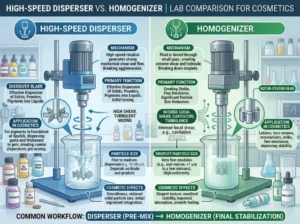
Table of Contents
1. What is a High-Speed Disperser?
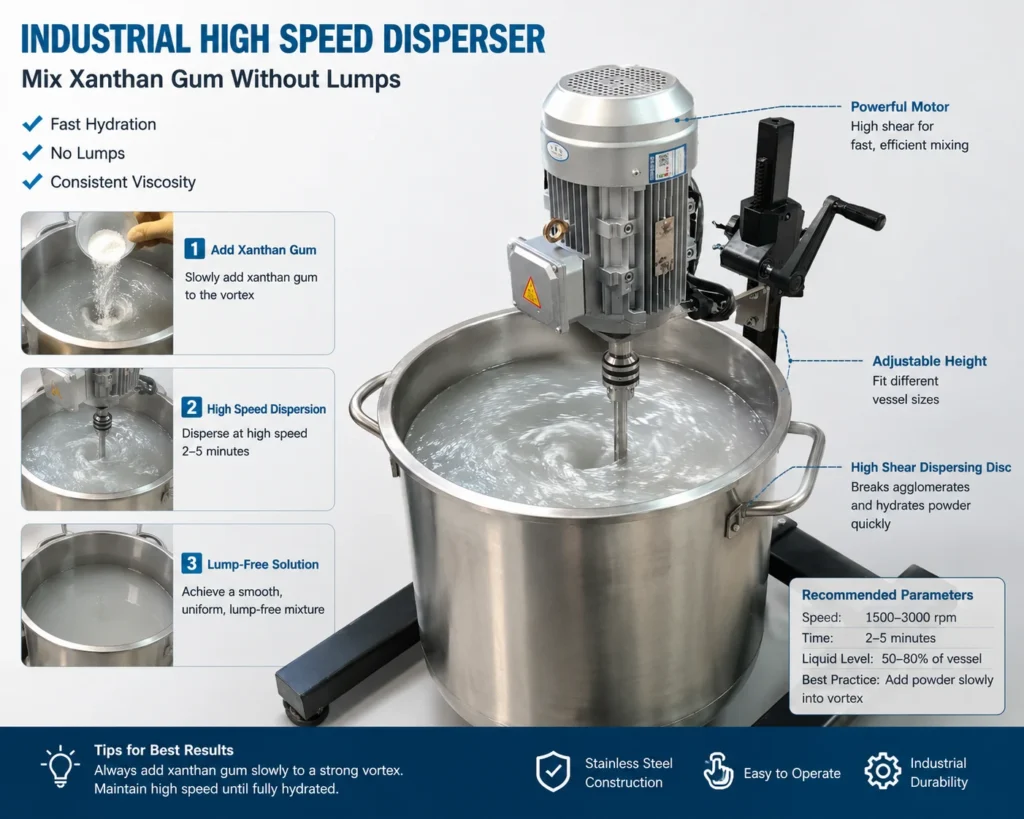
A high-speed disperser is a powerful mixing tool designed primarily for wetting powders into liquids. It features a saw-tooth blade attached to a rapidly rotating shaft. As the blade spins, it creates a deep vortex in the mixing vessel.
This vortex pulls dry ingredients down into the liquid, tearing apart loose agglomerates (clumps of powder). It is incredibly efficient for creating suspensions and dispersing pigments into oils or water.
If you are creating color cosmetics, nail polishes, or simple gel formulations, a disperser is often your first line of defense. However, if you are setting up a new lab, understanding the size and power you need is crucial. To avoid buying the wrong capacity, we highly recommend reading a comprehensive guide to selecting medium and small dispersers before making a purchase.
2. What is a Homogenizer?
While a disperser mixes and breaks down soft clumps, a homogenizer takes things to a microscopic level. It usually employs a rotor-stator mechanism. The rotor spins at incredibly high speeds inside a stationary stator.
As the cosmetic mixture is drawn into the workhead, it is subjected to intense mechanical and hydraulic shear. This process forces the liquid out through the narrow slots of the stator, breaking down oil droplets or solid particles into extremely fine, uniform sizes.
Homogenizers are the undisputed champions of emulsions. If you are making anti-aging creams, fine lotions, or sunscreen, a homogenizer ensures the oil and water phases bind perfectly, preventing separation over time.
3. High-Speed Disperser vs. Homogenizer: Core Differences
To truly settle the high-speed disperser vs. homogenizer debate, you need to look at three main factors: shear force, particle size reduction, and application.
Shear Force and Energy
A high-speed disperser provides moderate shear. It relies on the flow of the product (the vortex) and the impact of the blade. A homogenizer, on the other hand, provides intense high shear. It forces the product through a highly confined space, generating immense friction and pressure.
Particle Size Reduction
When comparing a high-speed disperser vs. homogenizer for particle reduction, the homogenizer wins hands down. A disperser can break down loose powder clumps, but it cannot significantly reduce the primary size of a solid particle. A homogenizer can reduce droplet sizes down to the micron or even nano level.
Viscosity Handling
Dispersers are fantastic for medium to high-viscosity products where moving the entire batch is important. Homogenizers are generally better suited for lower viscosities unless paired with anchor stirrers or scraper blades that push thick creams into the homogenizing head.
4. How to Choose Between a High-Speed Disperser vs. Homogenizer
Your choice ultimately depends on your specific cosmetic formulation. Let’s break it down by product type.
For Color Cosmetics and Pigments
If you are formulating liquid foundations, lip glosses, or nail polishes, you are dealing with heavy pigments like titanium dioxide or iron oxides. A disperser is perfect for wetting these powders and distributing them evenly without trapping excessive air.
For Lotions, Creams, and Serums
If your formula requires emulsifying oil and water, you absolutely need a homogenizer. Creams require tiny, uniform droplets to feel smooth and absorb well into the skin. A disperser simply does not have the shear power to create a stable emulsion on its own.
If you are looking to upgrade your manufacturing floor, it is vital to browse reliable cosmetic mixing equipment to find the exact machine tailored to your production volume.

5. Can You Use Both in Cosmetics?
Absolutely. In fact, many large-scale cosmetic manufacturers use a combination of both technologies. This completely shifts the high-speed disperser vs. homogenizer argument from “which one is better” to “how do they work together.”
A common setup involves using a high-speed disperser to quickly wet and incorporate bulk powders into the liquid phase. Once the rough mixture is combined, the batch is passed through an inline homogenizer. This two-step process dramatically reduces processing time, saves energy, and results in a perfectly smooth, highly stable cosmetic product.
6. Frequently Asked Questions (FAQ)
7. References
- Homogenization (Chemistry) – Wikipedia
- Dispersion Processes in Chemical Engineering – ScienceDirect
- Formulation and Stability of Cosmetic Emulsions – National Institutes of Health (NIH)
This is an incredibly detailed and well-written guide on selecting cosmetic mixers! As a professional in the industrial mixing and homogenizing equipment industry, I completely agree that matching the mixer type with the formulation’s viscosity is key to a stable emulsion.
Many startup cosmetic brands often overlook the importance of ‘high-shear’ capabilities when dealing with tight emulsions like creams and lotions. Standard mixing might blend ingredients, but achieving that silky, premium texture requires precise high-shear homogenization to reduce droplet size effectively.