Table of Contents
- Introduction to Food-Grade Lab Dispersers
- 1. Material Excellence: The Power of 316L Stainless Steel
- 2. Eliminating Hidden Risks: The Zero-Dead-Zone Design
- 3. Surface Roughness and Advanced Seal Integrity
- 4. Real-World Application: The Ultimate Sanitary Lab Mixer for Hot Sauce
- 5. From Formulation to Production: Scaling Your Food Process
- Frequently Asked Questions (FAQs)
- References & External Resources
Choosing a reliable sanitary lab mixer is one of the most critical decisions a food scientist or product developer can make.
When you are formulating products for human consumption, the stakes are incredibly high. A minor contamination issue can ruin months of research, trigger costly batch recalls, or compromise consumer health.
But what exactly transforms a standard laboratory disperser into a true, certified food-grade system?
In food R&D laboratories, high-shear mixing is utilized daily to create stable emulsions, break down particle sizes, and dissolve complex ingredients.
However, a standard mixer intended for chemical or industrial paint blending can easily harbor bacteria, oxidize when exposed to organic acids, and contaminate your samples.
To guarantee food safety and regulatory compliance, understanding the exact engineering criteria of a sanitary high-shear disperser is absolutely paramount.
1. Material Excellence: The Power of 316L Stainless Steel
The primary baseline for any high-performance hygienic mixer is its material composition.
In industrial and laboratory food processing, the industry gold standard is 316L stainless steel. Unlike standard 304 stainless steel—which is widely used in commercial kitchens but can fail under extreme laboratory conditions—316L contains a higher percentage of molybdenum and a significantly lower carbon content.
Why does this matter for food formulation? Food products are rarely chemically neutral. Many ingredients contain high concentrations of organic acids, salt, and moisture.
For example, when manufacturing condiments, dressings, or specialized sauces, the environment is highly corrosive. Standard metals will suffer from pitting corrosion over time, micro-contaminating the food batch with metallic ions.
Using 316L stainless steel ensures absolute chemical inertness, high temperature resistance, and unmatched durability during rigorous sterilization cycles.
2. Eliminating Hidden Risks: The Zero-Dead-Zone Design
Even if a piece of equipment is made of the finest materials, bad geometry can lead to catastrophic biological contamination.
This is where a specialized zero-dead-zone design becomes non-negotiable for a premium sanitary lab mixer.
A “dead zone” or “dead leg” refers to any area, pocket, crevice, or sharp corner within the mixing vessel or the mixing head where the fluid cannot easily circulate or be reached by cleaning solutions.
When processing food formulations, tiny particles of proteins, fats, or sugars can get trapped in these structural crevices.
Over time, these stagnant areas become absolute breeding grounds for bacterial biofilms, such as Listeria or Salmonella.
A true hygienic laboratory disperser features seamless, fully rounded corners (minimum radiuses), self-draining surfaces, and completely exposed, accessible threads.
Every single part that comes into contact with the product must be easily disassembled, inspected, and thoroughly cleaned, whether through manual scrubbing or Clean-In-Place (CIP) simulation processes.

3. Surface Roughness and Advanced Seal Integrity
Beyond visual inspections, the microscopic profile of the mixing components determines their hygienic status.
A professional laboratory food mixer must feature an ultra-smooth surface finish, typically measured in Ra (Roughness Average). For food-grade laboratory equipment, a surface roughness of Ra ≤ 0.8 micrometers (μm) is generally required, often achieved via mechanical polishing or advanced electropolishing.
When a surface is perfectly electropolished, microscopic peaks and valleys are flattened out. This prevents microscopic food particles from anchoring themselves to the metal.
Furthermore, the shaft seals must be engineered out of FDA-approved materials like PTFE (Teflon) or Viton.
Standard industrial mechanical seals can leak lubricants or shed black rubber particles into the mixture, which completely destroys batch purity.
Hygienic lip seals or food-grade mechanical seals ensure that the motor mechanics remain completely isolated from the food matrix.
4. Real-World Application: The Ultimate Sanitary Lab Mixer for Hot Sauce
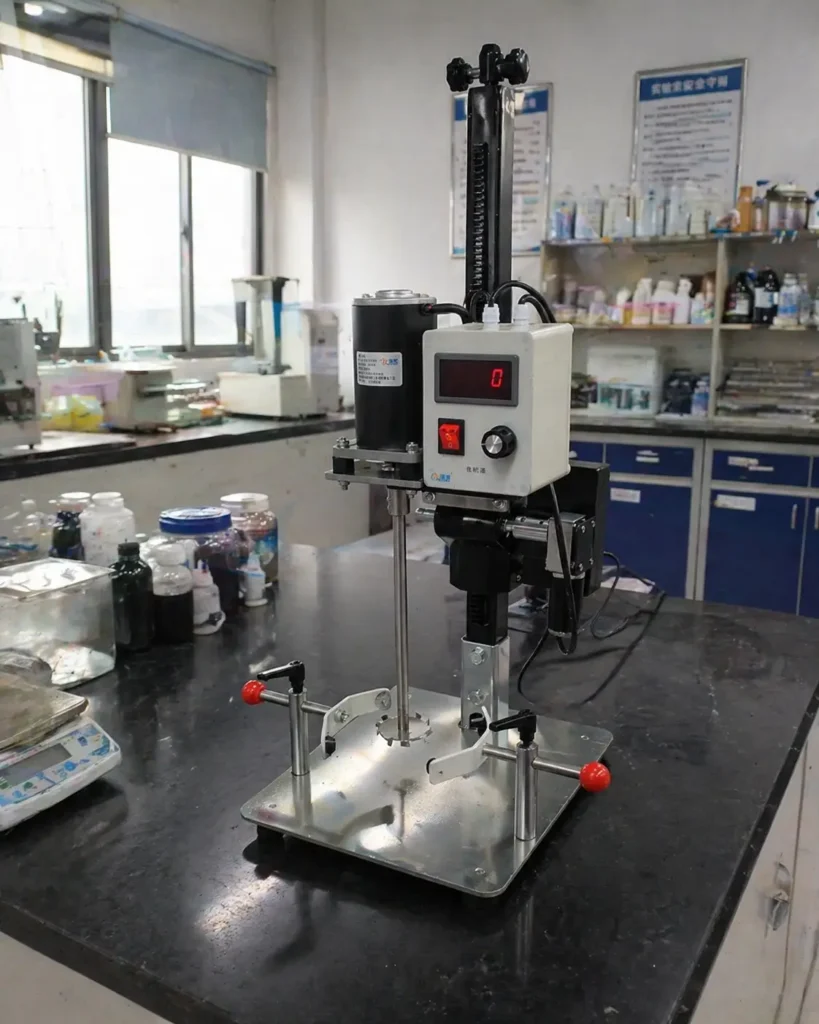
To visualize these stringent engineering requirements in action, let us take a look at a very popular real-world application: developing a recipe with a sanitary lab mixer for hot sauce.
Producing a premium hot sauce involves blending vinegar (acetic acid), salt, peppers (capsaicin), spices, and sometimes thickening agents like xanthan gum into a perfectly smooth, uniform emulsion.
This application presents multiple challenges simultaneously:
- High Acidity: The low pH of vinegar will rapidly corrode inferior steels, making 316L stainless steel an absolute requirement to avoid metallic off-flavors.
- Textural Uniformity: The high-shear stator-rotor mechanism must efficiently pulverize pepper skins and seeds without incorporating unwanted air.
- Pungent Residues: Capsaicin oils are incredibly sticky and pungent. Without a seamless, zero-dead-zone design, residual pepper oils and particulate matter from a previous batch will become trapped in the mixing head, leading to cross-contamination, flavor carryover, and rapid microbial spoilage in subsequent batches.
Using a properly engineered laboratory disperser ensures that your hot sauce achieves a stable shelf-life, excellent color distribution, and a silky texture while fully maintaining commercial food safety standards.
5. From Formulation to Production: Scaling Your Food Process
Developing a successful product in the lab is only half the battle. The ultimate goal is transferring that perfect small-scale recipe into a full-blown commercial production line.
When choosing laboratory equipment, it is wise to select a platform that shares the same geometric and kinematic profiles as larger industrial systems.
Reading an in-depth guide to selecting medium and small dispersers can offer exceptional clarity on how motor power, tip speed, and vessel capacities interact during the scale-up phase.
When your lab-scale hygienic disperser accurately mirrors the high-shear dynamics of a factory-scale inline or batch mixer, transitioning your food product becomes a seamless process.
You can confidently predict processing times, particle size distribution, and emulsification stability without needing to completely reinvent your formula when moving to larger volumes.
Frequently Asked Questions (FAQs)
Q1: Can I use a standard chemical laboratory mixer for food product development?
A: It is strongly discouraged. Standard chemical mixers often use 304 stainless steel or inferior alloys, contain non-food-grade lubricants, and feature structural dead zones that harbor bacteria. A certified food-grade lab mixer is required to ensure food safety and accurate shelf-life testing.
Q2: Why is 316L stainless steel preferred over standard 316 or 304 for a sanitary lab mixer for hot sauce?
A: The “L” stands for low carbon. 316L stainless steel is far more resistant to intergranular corrosion and pitting caused by the high acetic acid (vinegar) and salt content found in hot sauce formulations, ensuring zero metallic contamination.
Q3: How do I properly clean a zero-dead-zone laboratory disperser?
A: Thanks to the zero-dead-zone design, these mixers can be rapidly disassembled. Most high-quality units allow you to remove the stator and rotor quickly for autoclaving, manual rinsing, or running a short cleaning cycle with food-safe detergents directly inside the mixing vessel.
Q4: What surface roughness value should I look for in food-grade laboratory equipment?
A: You should look for a surface roughness profile of Ra ≤ 0.8 μm. This polished surface prevents microscopic food particles and bacterial cultures from adhering to the metal parts.
References & External Resources
For more technical details on food-grade sanitary standards, engineering protocols, and laboratory mixing dynamics, please explore the following authoritative resources:
- 3-A Sanitary Standards Inc. (SSI) – Industry-led association dedicated to advancing hygienic equipment design for the food, beverage, and pharmaceutical industries.
- European Hygienic Engineering & Design Group (EHEDG) – Global network offering practical guidance on hygienic engineering to ensure safe food manufacturing.
- U.S. Food and Drug Administration (FDA) – Official regulatory updates regarding food contact substances, material approvals, and CGMP requirements.