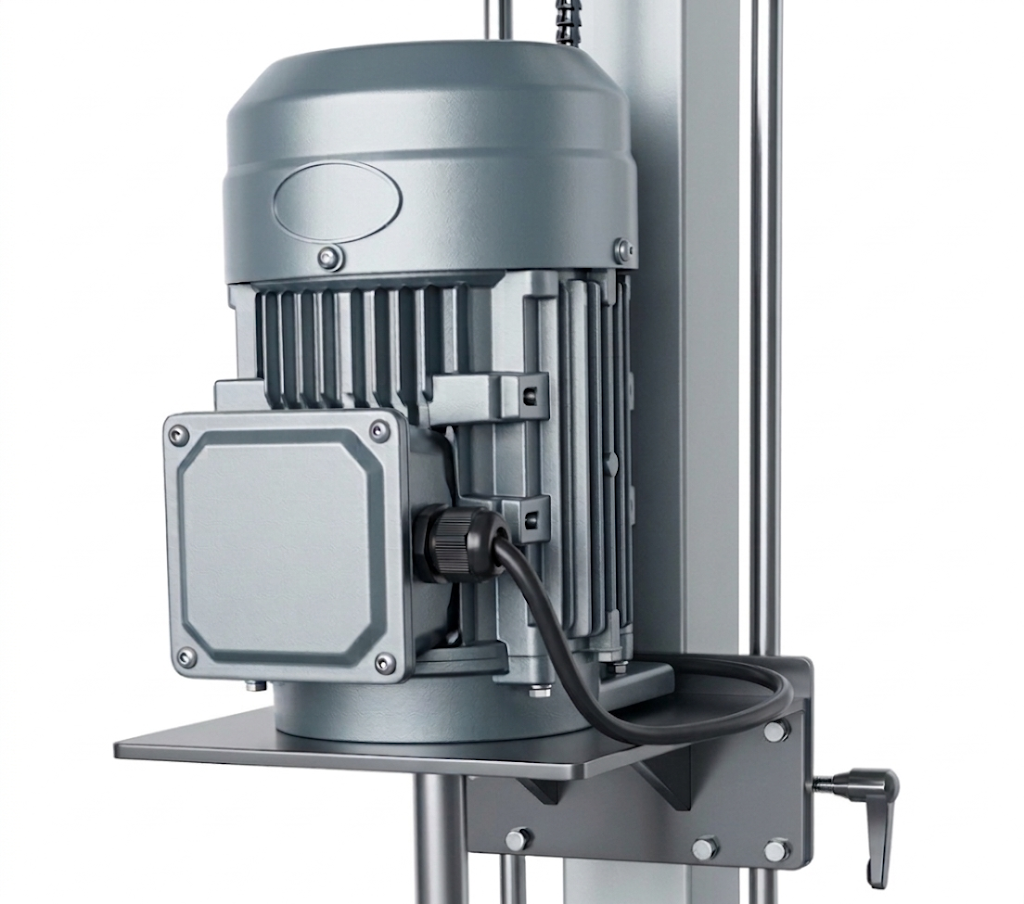
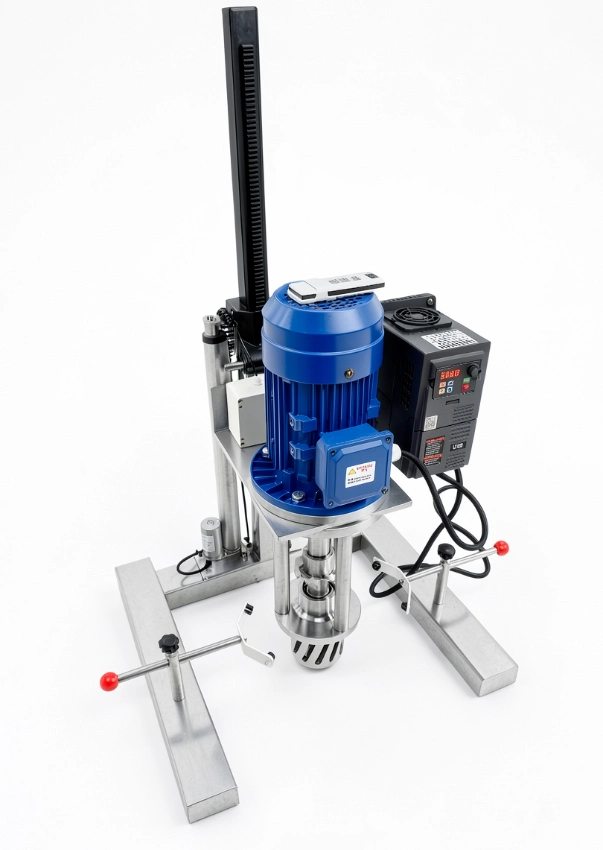
Choosing a high-speed disperser for a 100-liter batch starts with the material, not only the tank size. A 3 kW machine may suit some low- or medium-viscosity materials, but it is not the right choice for every 100-liter process.
Before selecting a model, check the viscosity, solids content, working volume, vessel dimensions, dispersing disc, and required result. These details determine how much power and torque the process needs.
Quick answer: A 100-liter capacity label does not prove that a machine can process 100 liters of your material. The actual working volume depends on the complete process.
A 100-Liter Vessel Is Not a 100-Liter Working Batch
A vessel should not always be filled to its total capacity. The material needs room to move. You may also need space for powder addition, vortex control, and changes in volume during processing.
Confirm these three numbers:
- Vessel capacity: the total amount the container can hold.
- Starting volume: the liquid in the vessel before powders or pigments are added.
- Working volume: the amount that can circulate safely during dispersion.
Also measure the vessel’s inside diameter and height. Two 100-liter vessels can have different shapes, and this changes the shaft position, disc clearance, and material flow.
Can a 3 kW High-Speed Disperser Handle 100 Liters?
Possibly, but batch volume alone is not enough to answer this question. The same 100-liter volume can place very different loads on the motor.
- A thin water-based coating may move easily.
- A high-solids paint may become much thicker after powder addition.
- A resin or adhesive may need more torque than high speed.
- A pigment concentrate may need a different disc and a smaller working batch.
The YAKU FS-3KW variable-speed high-speed disperser can be reviewed as one option. Its suitability must still be confirmed from the real material, vessel, disc, speed, and operating duty.
Different Viscosities Need Different Mixing Solutions
Not every material needs the same drive system. Some processes need high speed. Others need low-speed torque, vacuum, or more than one mixing action.
| Material or Process | What to Review |
|---|---|
| Low-viscosity liquid | High-speed single-shaft disperser, VFD speed control, disc size, and vessel flow |
| Medium-viscosity material | Motor load, torque, solids content, disc diameter, and run time |
| High-viscosity material | Gear-reduced low-speed, high-torque agitation or a multi-shaft configuration |
| Material that traps air | Vacuum dispersion or a separate deaeration step |
| Process requiring finer particles | High-speed pre-dispersion followed by suitable milling equipment |
For high-viscosity materials, a gear reducer can provide lower speed and higher torque. In many cases, the process may need both a high-speed dispersing shaft and a slow-speed agitator. A multi-shaft mixer can be reviewed for this type of work.
If air removal is important, compare the process with a vacuum disperser. YAKU can review different solutions based on the viscosity, batch volume, vessel size, and target result. The goal is to match the machine to the process rather than force every material into one model.
The Motor, Disc, and Vessel Must Work Together
Motor and Speed
A larger motor is not automatically better. The motor must provide enough load capacity for the material, disc, speed, and run time. Maximum RPM alone does not show whether the batch will disperse correctly.
Dispersing Disc
The disc must suit the vessel diameter and material. A disc that is too small may not circulate the full batch. A disc that is too large may overload the drive. Review the available dispersing discs and parts when another tool size is needed.
Vessel Shape
Vessel diameter, height, opening, and working volume affect circulation. Send the actual vessel dimensions instead of only saying “100 liters.”
Common 100-Liter Batch Applications
A 100-liter disperser configuration may be reviewed for:
- Water-based paints and coatings
- Inks and pigment dispersions
- Resins and compatible adhesives
- Color pastes and emulsions
- Compatible chemical liquids
These application names do not confirm machine suitability. Final selection still depends on the formulation and working conditions. If the viscosity is unknown, use this guide to measure liquid viscosity as a starting point.
What to Send Before Requesting a Quote
- Material name and intended application
- Approximate viscosity, density, and solids content
- Minimum and maximum working volume
- Vessel inside diameter and height
- Required dispersion or mixing result
- Run time and batches per day
- Voltage, phase, and frequency
- Hazardous-area requirements, if applicable
- A short material-flow or current-process video
Frequently Asked Questions
Is 3 kW always enough for a 100-liter batch?
No. The required power depends on viscosity, density, solids content, disc size, speed, and run time.
Can I fill a 100-liter vessel completely?
Not always. The process may need space for material movement, powder addition, and splash control. Confirm the working volume.
Why can high-viscosity material need a gear reducer?
A gear reducer lowers speed and increases available torque. This may help move thick material, but the final system may also need a multi-shaft arrangement.
Do solvent-based materials need an explosion-proof machine?
This depends on the site’s hazardous-area classification and local requirements. The complete motor, controls, and electrical system must be reviewed. See the explosion-proof disperser guide.
How do I choose the dispersing-disc size?
Disc size must be checked with the vessel diameter, material viscosity, motor, operating speed, and target result.
Need a Disperser for a 100-Liter Batch?
Send YAKU your material, viscosity, working volume, vessel dimensions, voltage, and required result. We can review a high-speed disperser, gear-reduced mixer, multi-shaft mixer, or vacuum solution for your process.