Why slip and glaze batches turn grainy or separate, and how to stop it.
You mix your glaze or slip, and it looks fine in the bucket. A day later, the heavy part has settled hard at the bottom. Or worse, your cast pieces come out with thin spots and pinholes.
Most of the time, this isn’t a recipe problem. It’s a sign the powder never got fully broken apart and spread through the water in the first place.
Why Ceramic Powder Is Harder to Mix Than It Looks
Ceramic powder is heavy, much heavier than water. If the particles clump together instead of separating, those clumps are even heavier, and they sink fast.
The powder also needs real energy to wet properly. Each particle needs water to reach its full surface, not just the outside of a clump. Gentle stirring often leaves the inside of clumps dry, even when the top of your batch looks smooth.
The Balance That Makes This Tricky
Ceramic slips and glazes need to carry a lot of solid powder while staying thin enough to pour, spray, or cast into a mold. Add too much water to make it flow easily, and your batch gets weak or slow to dry. Add too little, and it’s too thick to work with.
This is where a dispersant, sometimes called a deflocculant, comes in. It helps keep the particles separated in the liquid, so you can pack in more powder without the batch turning into a paste. Getting the dispersant amount right matters, but it only works if the powder was actually broken apart during mixing in the first place.
A Simple Process That Works
- Start mixing the water first. Never add ceramic powder into still water.
- Sift the powder in slowly. A steady, thin addition beats dumping it in all at once, every time.
- Mix with enough force to fully wet each particle. This is the step that actually prevents dry cores from hiding inside clumps.
- Add your dispersant as planned in your recipe. It works best on powder that’s already spread out, not on clumps.
- Check for smoothness and pourability. A well-mixed batch should flow evenly with no grit and no separation after it rests for a bit.
Why Stronger Mixing Prevents Settling Later
Settling isn’t just about how heavy the powder is. It’s about whether individual particles are evenly coated and separated, or clumped into heavier groups.
A high-speed disperser creates a strong vortex that pulls powder in and spreads it thin right away, rather than letting particles clump before the water can reach them. This is closer to how pigment settling gets prevented in paint batches, and the same core idea applies here: break it apart fully, and it stays suspended much longer.
Setup for Small-Batch Production
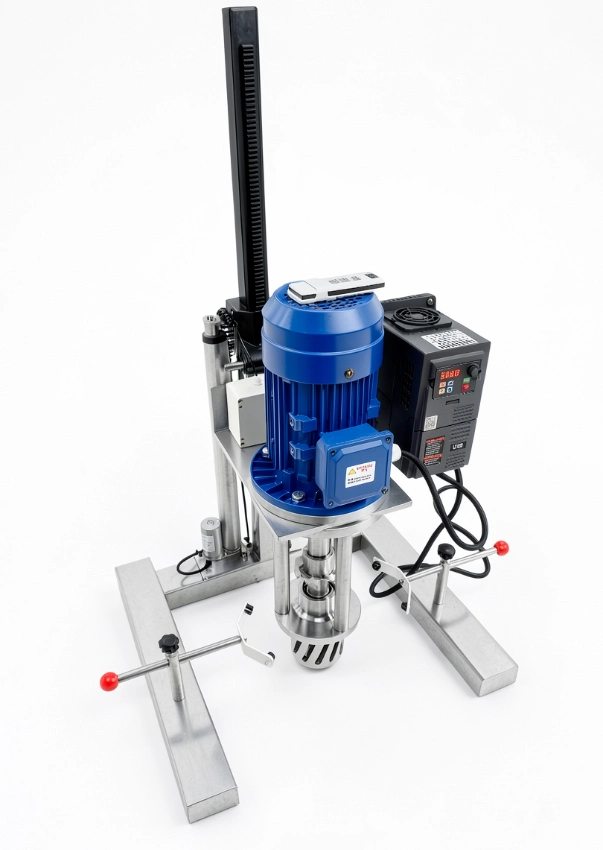
Small ceramic studios and technical ceramic producers don’t need a giant industrial blunger for this. A variable-speed disperser, sized to your batch and paired with the right blade for a dense, heavy slurry, handles most slip and glaze batches well.
A digital display lets you repeat the exact mixing time and speed that gave you a smooth, stable batch, so casting results stay consistent from one run to the next.
If you’re not sure what blade or setup fits a dense, heavy material like ceramic slip, this blade selection guide can help you match it correctly. And if you’re moving from small test batches into regular production, this sizing guide can help you pick the right model.
Common Questions
Can ceramic powder be mixed directly into water?
Yes, but sift it in slowly while the water is already being mixed. Dumping a large amount in at once, or adding water to a pile of dry powder, makes clumping much worse.
Why does my ceramic slip settle even after mixing well?
Ceramic powder is dense and heavy compared to water. If particles aren’t fully broken apart and coated during mixing, they clump into heavier groups that sink faster than individual particles would.
Do I need a dispersant to mix ceramic powder?
For most slips and glazes, yes. A dispersant keeps the powder suspended and lets you reach a higher solids content without the batch turning too thick to pour or cast.
Can a high-speed disperser mix ceramic slip or glaze?
Yes. Ceramic powders need real mixing force to fully wet every particle, which is exactly what a high-speed disperser is built to do for small and medium batches.
Small Wrap-Up
Grainy glaze and settling slip almost always trace back to the same thing: powder that wasn’t fully broken apart during mixing. Add it slowly into moving water, mix with enough force to wet every particle, and the results stay smooth and stable batch after batch.
Working with ceramic slip, glaze, or technical ceramic slurries? Send us your batch size and recipe, and we’ll help you find a setup that stays consistent every time.