Graphite powder is widely used in conductive coatings, lubricants, paints, inks, batteries, refractories, and other industrial applications.
But dispersing graphite powder into a liquid is not always easy.
You may notice that the graphite forms floating lumps, settles quickly at the bottom, or produces an uneven and unstable mixture. Increasing the mixing time does not always solve the problem.
The key is not simply to “mix faster.” It is to properly wet, disperse, and stabilize the graphite particles.
Why Does Graphite Powder Settle?
Graphite is a high-density solid powder. When added to a liquid, poorly dispersed particles tend to remain as larger agglomerates.
These larger particles settle more easily because the liquid cannot keep them uniformly suspended. This is the same underlying issue covered in our guide on preventing pigment settling, and the same fixes generally apply.
Several factors can contribute to settling:
- Large graphite agglomerates
- Insufficient shear
- Poor powder wetting
- Incorrect addition method
- Low liquid viscosity
- Insufficient stabilizer or dispersant
- Improper mixing speed
Simply increasing the mixing time may not provide enough shear to break down graphite agglomerates.
Why Does Graphite Powder Form Lumps?
Graphite powder can develop dry pockets or floating clusters when it contacts liquid too quickly.
The outside of the agglomerate becomes wet while the powder inside remains dry.
This creates a common problem:
Wet outside + dry inside = incomplete dispersion
Once these agglomerates become large and compact, they can be difficult to break apart. This same wet-outside, dry-inside pattern shows up in other hydrophobic powders too — we cover it in detail in how to disperse carbon black in water, if you’re mixing both materials.
That is why the powder addition process is just as important as the mixer itself.
How to Disperse Graphite Powder More Effectively
1. Start With the Liquid Phase
Add the main liquid into the mixing tank first.
Start agitation before adding graphite powder.
This creates circulation inside the vessel and helps the powder enter the liquid more evenly.
2. Add Graphite Powder Gradually
Avoid dumping the entire bag of graphite into the tank at once.
Instead, add the powder gradually near the high-shear mixing zone.
This gives each portion of graphite a better opportunity to become wetted.
For fine graphite powder, controlled feeding can significantly reduce floating powder and large agglomerates.
3. Use Enough Shear
Graphite particles often require more than simple low-speed stirring.
A high speed disperser can generate strong shear around the dispersion blade.
The objective is to break down agglomerates and distribute graphite particles throughout the liquid.
The ideal speed depends on:
- Graphite particle size
- Graphite concentration
- Liquid viscosity
- Batch size
- Blade diameter
- Tank geometry
- Desired dispersion quality
Higher speed is not automatically better. Excessive speed can introduce unnecessary air and create vortex problems. If you’re unsure which blade shape fits your recipe, this blade selection guide walks through how to match blade type to viscosity.
4. Control the Vortex
A deep vortex may look like good mixing, but it can also pull excessive air into the mixture.
Air entrainment can lead to:
- Foam
- Bubbles
- Oxidation concerns in certain systems
- Longer processing time
- Poor final appearance
Adjust the blade position, speed, and batch conditions to maintain effective circulation without excessive air entrainment. For batches where trapped air is a bigger concern, some producers use vacuum dispersers to pull air out during mixing instead of relying on speed adjustments alone.
5. Adjust the Liquid Formulation
In some applications, graphite does not remain suspended easily after dispersion.
The formulation may require an appropriate dispersant, wetting agent, or viscosity modifier.
The correct additive system depends on the liquid and final application.
For example, a graphite dispersion for a conductive coating may require a different formulation approach from graphite dispersed in a lubricant or water-based system.
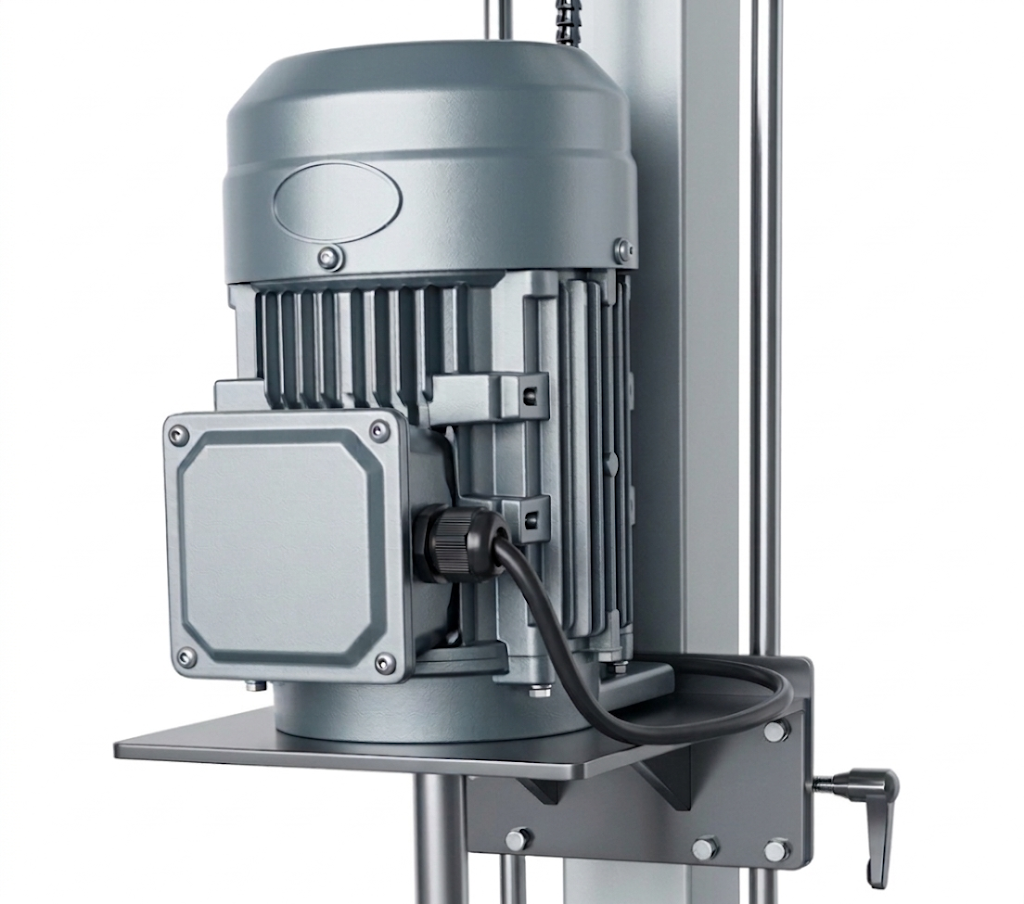
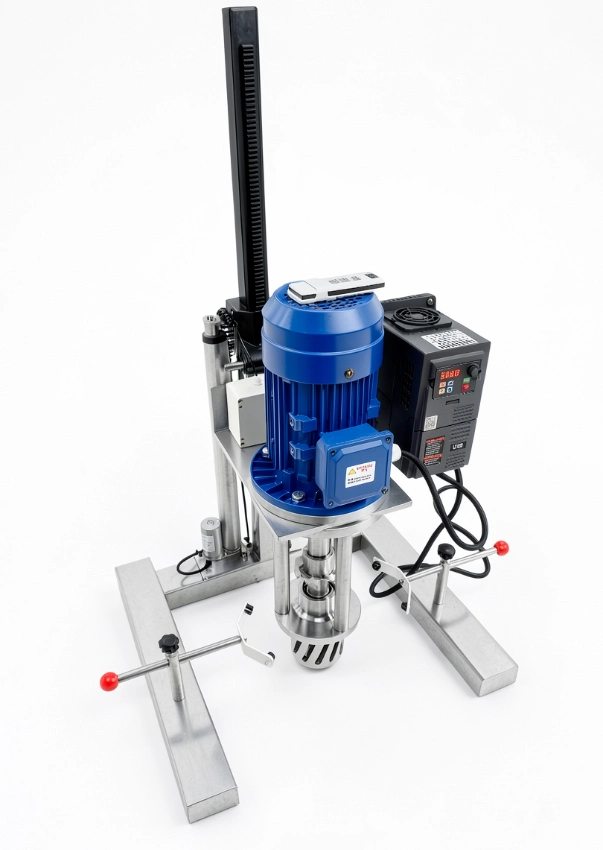
High Speed Disperser for Graphite Powder
A high speed disperser is commonly used when the goal is to break down graphite agglomerates and achieve a more uniform solid-liquid dispersion.
For small-batch production and laboratory development, a compact disperser can provide a practical solution without requiring a large industrial mixing system. Our lab dispersers are commonly used at this stage to test settings on a small sample before scaling up.
The machine selection should be based on the actual process rather than batch volume alone.
Consider:
| Factor | Why It Matters |
|---|---|
| Batch volume | Determines suitable machine capacity |
| Graphite concentration | Higher solid loading may require more power |
| Viscosity | Influences circulation and shear |
| Particle size | Affects dispersion difficulty |
| Required fineness | Determines processing requirements |
| Liquid type | Influences wetting and stabilization |
| Production target | Determines appropriate equipment size |
What Type of Graphite Mixing Process Do You Need?
Not every graphite application requires the same mixing equipment.
For a low-viscosity graphite slurry, efficient circulation and controlled powder addition may be sufficient.
For higher-solid-content or more difficult formulations, stronger shear may be required. Our guide on mixing high-viscosity paint covers similar shear and circulation challenges if your graphite system runs thick.
For applications requiring extremely fine particle-size reduction, a high speed disperser alone may not be sufficient. Additional equipment, such as a bead mill or other grinding system, may be required depending on the target particle size.
This distinction is important:
A disperser breaks down agglomerates and distributes particles. It is not automatically a substitute for a grinding mill.
Common Applications of Graphite Dispersions
Graphite powder can be dispersed for many applications, including:
- Conductive coatings
- Conductive inks
- Lubricants
- Paints and coatings
- Battery-related formulations
- Refractory materials
- Industrial compounds
- Antistatic coatings
The best mixing process depends heavily on the final formulation and application requirements.
How to Choose a Disperser for Graphite Powder
Before selecting a machine, provide the equipment supplier with several key parameters. This sizing guide walks through how each of these factors affects the right model for your batch:
1. Batch size:
How many liters do you need to process per batch?
2. Graphite loading:
What percentage of graphite powder is used?
3. Liquid viscosity:
Is the system water-like, medium-viscosity, or highly viscous?
4. Particle size:
What is the starting graphite particle size?
5. Final dispersion requirement:
Do you need simple uniform dispersion or a very fine dispersion?
6. Production target:
Is the machine for laboratory trials, pilot production, or continuous manufacturing?
With this information, the appropriate disperser size, motor power, speed range, and blade configuration can be evaluated more accurately. Our best disperser for small-batch production guide is a good next step if you’re sizing for a small or medium run.
Graphite Powder Dispersion Troubleshooting
Graphite floats on the surface
Possible causes include poor wetting, incorrect powder addition, or insufficient circulation.
Try adding graphite more slowly and feeding it closer to the high-shear zone.
Graphite settles quickly
The particles may not be sufficiently dispersed, or the formulation may have insufficient suspension stability.
Check particle agglomeration, viscosity, and dispersant selection.
Large black lumps remain
The powder may have been added too quickly or the available shear may be insufficient.
Reduce the feeding rate and evaluate whether a higher-shear dispersion process is required.
Excessive foam appears
The mixing speed may be too high, or the vortex may be drawing too much air into the batch.
Adjust the operating speed and blade position.
Final Thoughts
Successfully dispersing graphite powder is not simply a matter of running a mixer for a longer time.
The result depends on the combination of powder addition, wetting, shear, formulation, mixing speed, and equipment selection.
For small-batch development and production, a suitable high speed disperser can provide the shear needed to break down graphite agglomerates and produce a more uniform dispersion.
Before choosing a machine, evaluate your graphite concentration, batch size, viscosity, particle size, and required dispersion quality.
Need help selecting a disperser for your graphite formulation?
Send us your graphite concentration, batch volume, liquid type, and viscosity, and YAKU can recommend a suitable dispersing solution.