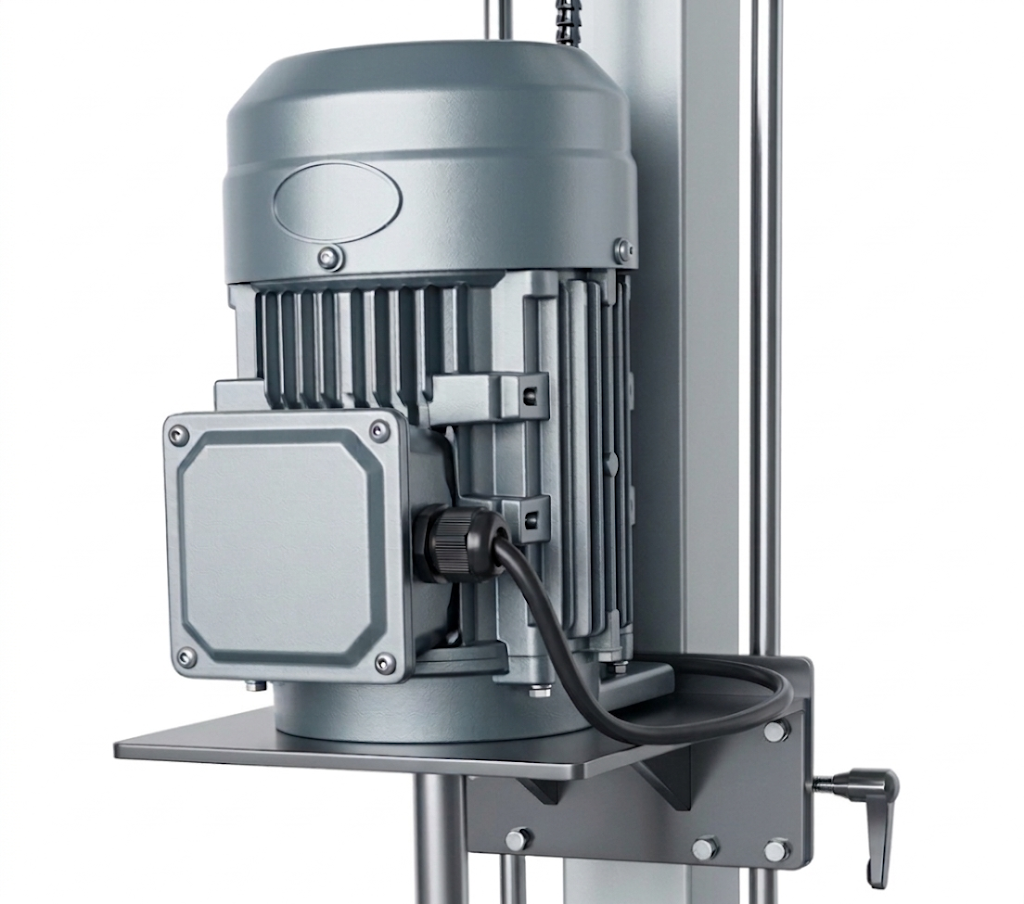
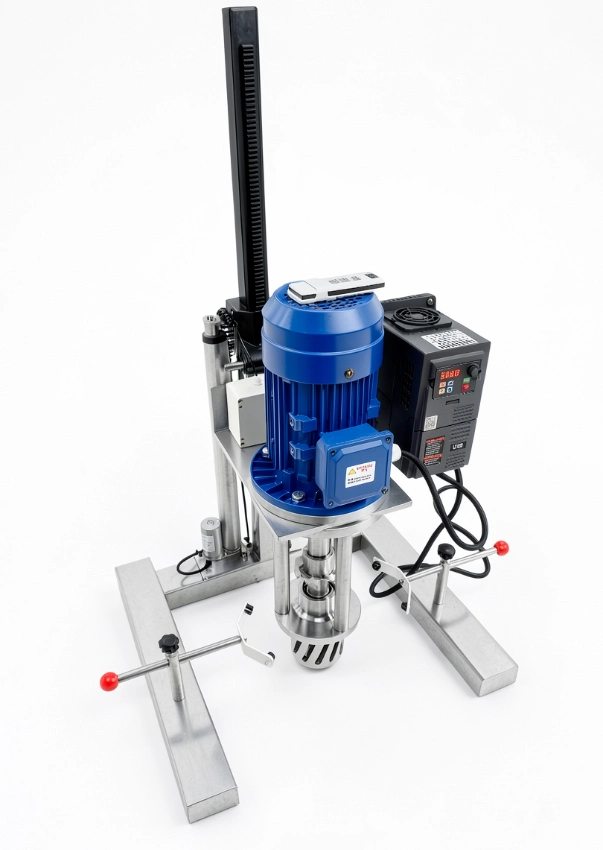
I’ve watched too many R&D teams make the same expensive mistake: buying a piece of equipment designed for a factory floor when all they really needed was a lab disperser that fits on a benchtop.
If you’re running a startup, a university lab, or a contract R&D facility, you probably don’t need a hydraulic disperser that handles 500-gallon batches. In fact, buying one too early can bleed your budget dry — between the upfront cost, the wasted raw materials, and the hours lost to cleaning between runs.
This article breaks down exactly when a benchtop lab disperser is the better call, using real-world numbers and use cases from the coatings, cosmetics, new materials, and specialty chemicals industries.
What Is a Lab Disperser?
A lab disperser — also called a laboratory high-speed disperser or benchtop disperser — is a compact, high-shear mixing device designed for small-volume work. Think beakers, not drums. Most benchtop models handle anywhere from 50 mL to 20 L, with rotor speeds reaching 3,000–10,000 RPM. They use interchangeable dispersion blades (saw-tooth discs, propeller paddles, rotor-stator heads) to break down agglomerates, wet out powders, and create stable suspensions or emulsions at lab scale.
In contrast, an industrial disperser is built for production — ton-scale batches, hydraulic lifts, fixed tanks, and floor-mounted motors that draw industrial power. The two machines solve fundamentally different problems.
1. Your Batch Sizes Don’t Justify Industrial Equipment
Let’s be honest: if your “production run” is 5 liters, you don’t need a machine built for 1,000 liters. Most lab dispersers handle volumes from a few hundred milliliters up to 20 liters — perfect for trial batches, pilot runs, and small-batch custom orders.
Industrial dispersers have a minimum working volume too. Try dispersing 500 mL of a new pigment formulation in a 200-liter tank, and the blade won’t even touch the liquid. You’ll end up buying a lab disperser anyway — after you’ve already sunk $30K+ into equipment you can’t use for 80% of your work.
Many specialty chemical and cosmetic startups operate on “high-mix, low-volume” models. A benchtop disperser is purpose-built for exactly that workflow.
2. Material Waste Kills R&D Budgets
R&D materials are expensive. Pharmaceutical excipients, specialty pigments, functional nanoparticles — some of these cost hundreds of dollars per gram. When you’re developing a new formulation, you might run 20 or 30 iterations before you nail the recipe.
With a lab disperser, you can test a formula in a 200 mL beaker using just a few grams of material. With an industrial machine, the minimum batch might consume 5–10 kg of raw ingredients per trial — multiply that by 30 iterations, and you’ve burned through thousands of dollars before you’ve even validated your formula.
According to research on high-shear mixing, lab-scale rotor-stator devices can achieve comparable shear rates to production units while using a fraction of the material — making them ideal for formulation development and scale-up studies.
3. Frequent Changeovers Demand Speed, Not Tonnage
R&D labs and startup production lines don’t run one product all day. You might disperse a pigment paste in the morning, switch to a silicone emulsion by noon, and finish with a ceramic slurry in the afternoon.
Industrial dispersers are nightmares to clean between batches. You’re dealing with a large tank, a fixed shaft, and often a hydraulic lift system. A full clean-and-swap cycle can take 45–90 minutes — and that’s if you have the right cleaning equipment on hand.
A benchtop lab disperser with a quick-release chuck design lets you swap dispersion blades in under a minute. Rinse the shaft and blade, snap in a new one, and you’re running the next formula. For labs doing 4–6 changeovers a day, that difference alone can save 3–5 hours of downtime daily. The right dispersing disc paired with quick-swap hardware makes all the difference here.
4. Space and Power Constraints Are Real
Walk into a typical startup lab or a university research space. You’ll see benches, fume hoods, storage cabinets — not 20-foot ceilings and 480V three-phase outlets.
A floor-standing industrial disperser needs a dedicated footprint of at least 4×4 feet, ceiling clearance for the hydraulic lift, and a high-amperage power supply that most small labs simply don’t have. A lab disperser sits on your bench, plugs into a standard wall outlet, and weighs 15–30 kg — light enough to move around as your workflow changes.
If you’re operating out of a shared lab, a co-working space, or a converted office building, a benchtop unit is your only realistic option — and it works perfectly well for the volumes you actually handle.
5. Precision Matters More Than Raw Power
An industrial disperser gives you horsepower. A lab disperser gives you control. For R&D, that’s the trade-off that matters.
Modern benchtop laboratory dispersers come with digital speed readouts, precise RPM control (often ±1 RPM), and real-time monitoring. You can run a dispersion at exactly 3,500 RPM for exactly 15 minutes, repeat the same parameters tomorrow, and get the same result — critical when you’re building a formulation database or preparing for scale-up.
Many high-end benchtop models now use brushless DC motors or servo motors for quieter operation, longer runtime, and speed stability that older AC-motor industrial units struggle to match. Vacuum dispersers at lab scale add another layer of process control — degassing while dispersing, which is essential for electronics materials and high-clarity coatings.
6. One Machine, Multiple Jobs
A lab disperser isn’t just a disperser. Swap the blade, and it’s a completely different tool:
- Saw-tooth disc → high-shear pigment and powder dispersion
- Three-blade propeller → low-viscosity blending and mixing
- Rotor-stator head → emulsification and homogenization
- Butterfly paddle → medium-to-high viscosity stirring
That’s four functions from one motor. You’d need four separate industrial machines — or at minimum four dedicated mixing vessels — to cover the same range at production scale.
Safety-wise, modern lab dispersers come with overload protection and thermal cutoff switches. If you’re running the machine in a small room, in a home studio, or in an office-converted lab space, that peace of mind matters. No one wants a brush-type motor overheating during a 2-hour dispersion cycle.
7. The ROI Math Speaks for Itself
Let’s put numbers to it. Here’s a rough comparison for an R&D-focused operation:
| Factor | Benchtop Lab Disperser | Industrial Floor Disperser |
|---|---|---|
| Equipment cost | $1,500–$5,000 | $25,000–$80,000+ |
| Installation | Plug-and-play | Rigging, electrical work, floor anchoring |
| Minimum batch | 50–200 mL | 50–200 L |
| Material cost per trial (est.) | $5–$50 | $200–$2,000+ |
| Cleaning time between runs | 2–5 minutes | 30–90 minutes |
| Floor space | Bench (~2 sq ft) | 16–25 sq ft + clearance |
For most startups and R&D labs, a high-quality lab disperser pays for itself within the first month — just on saved materials alone. And when you do eventually scale to production volumes, your benchtop unit doesn’t become obsolete; it becomes your development and QC station.
Who Should Use a Benchtop Lab Disperser?
Through years of working with customers across industries, we’ve seen lab dispersers become essential tools in these environments:
- University and corporate R&D labs — Developing new coatings, adhesives, battery slurries, ceramic pastes, and pharmaceutical suspensions.
- Fine chemical and new material startups — Low-volume, high-value production where every gram of raw material counts.
- Independent formulators and cosmetic studios — Crafting small-batch skincare, haircare, and color cosmetics with precise texture control.
- Large manufacturers’ QC and incoming-inspection labs — Testing every raw material shipment for dispersibility before it reaches the production floor.
- Paint, ink, and pigment labs — Running drawdowns and small-batch color matching with exact dispersion parameters.
If any of these sound like your operation, a benchtop lab disperser is likely all the equipment you need right now. You can always add production-scale equipment later — but starting small keeps you fast, lean, and adaptable.
FAQ: Lab Disperser Questions Answered
What is a lab disperser used for?
A lab disperser is used for small-scale high-shear mixing, particle size reduction, powder wetting, emulsification, and homogenization in research and development settings. It handles volumes from ~50 mL to 20 L across industries like coatings, cosmetics, pharmaceuticals, and advanced materials.
How is a lab disperser different from an industrial disperser?
The main difference is scale and design. A lab disperser is benchtop-sized, handles small volumes, plugs into standard outlets, and prioritizes precision control. An industrial disperser is floor-mounted, handles ton-scale batches, requires industrial power and dedicated floor space, and is built for high-volume production runs. For more details, see our full product comparison.
How much does a lab disperser cost?
A quality entry-level lab disperser starts around $1,500–$2,000 for a basic brushless motor model. High-end units with servo motors and vacuum capabilities range from $3,000–$8,000. Compare that to industrial dispersers at $25,000–$80,000+, and the cost advantage for R&D is clear.
Can I use a lab disperser for small production runs?
Yes. Many startups and contract manufacturers use a lab disperser for batches up to 10–20 L. If your orders are consistently small and your product mix changes frequently, a benchtop unit can serve as your primary production tool — no industrial equipment needed.
What industries need a lab disperser most?
Coatings and paints, cosmetics and personal care, battery and energy materials, pharmaceuticals, advanced ceramics, adhesives and sealants, inks and digital printing, and food science all rely on lab dispersers for formulation development and quality testing.
What dispersing disc should I use for my application?
It depends on your material and target viscosity. Saw-tooth discs work best for powder dispersion in low-to-medium viscosity liquids. Propeller blades are better for blending. For viscous pastes, consider a butterfly paddle. Check our dispersing discs and parts guide for detailed recommendations.
Conclusion
If you’re running an R&D lab, a startup, or a small-batch production line, a lab disperser gives you everything you need: precise control, quick changeovers, minimal material waste, and a tiny footprint — all at a fraction of what industrial equipment costs.
YAKU has been building high-shear dispersion equipment for years, with a focus on benchtop and small-scale systems that don’t compromise on build quality. Our lab dispersers use brushless DC motors and optional servo drives for speed stability that holds across hours of continuous operation. All models support quick-swap dispersion blades, so one motor handles every mixing task in your lab. And with pricing starting under $2,000, they’re within reach whether you’re a funded startup or a solo formulator working from a home studio.
Want to see which model fits your materials? Browse our lab disperser lineup or reach out to our application engineers — tell us what you’re mixing, and we’ll tell you which setup works.
References
- High-shear mixer — Wikipedia
- Zhang, J., Xu, S., & Li, W. (2012). High shear mixers: A review of typical applications and studies on power draw, flow pattern, energy dissipation and transfer properties. Chemical Engineering and Processing: Process Intensification, 57–58, 25–41.
- Laboratory disperser manufacturers — DirectIndustry
- More dispersion and mixing guides — YAKU Blog